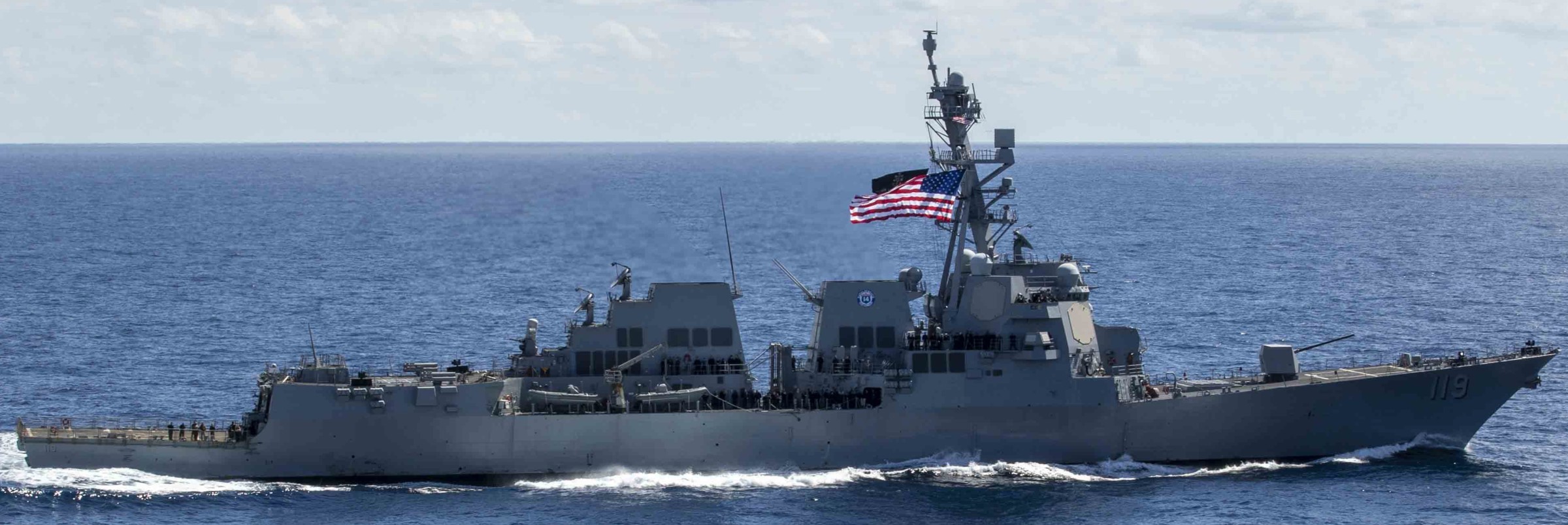
In a strategic move anticipating the future of naval warfare, the United States Navy is considering establishing a pivotal new position: a commander for robotic autonomous systems (RAS). This major decision underscores the Navy’s intense efforts to integrate unmanned capabilities into the existing fleet structure, according to the vision of Admiral Daryl Caudle, Chief of Naval Operations.
A New Strategic Vision for Naval Warfare
Admiral Caudle unveiled plans to employ a „hedge force strategy,” designed to capitalize on unmanned systems and create a range of tailored options by combining various technologies. This initiative is central to his new operational framework, titled „Fighting Instructions,” which directs the Navy to fully understand and embrace RAS within its command structure.
The Robotic Commander: A Pivotal Role in the Future Fleet
„This RAS commander, if you will, knows how to command and control these packages of unmanned capabilities to achieve the mission outcomes that the strike group commander may want,” Admiral Caudle explained to reporters at the WEST 2026 conference in San Diego. His vision goes even further, foreseeing a „RAS warfighting commander — it’s almost a joint task force commander just for these systems alone.” The details of this role are still being fleshed out as Caudle tackles the „unmanned dilemma”: how to effectively organize RAS capabilities. Currently, RAS are arranged by domain—undersea, aviation, and cyber. A RAS commander, however, could coordinate actions across all these domains, providing an integrated view. „I can easily see a robotic and autonomous system commander, you know, as a first instantiation on the strike group staff,” the Admiral added.
The Challenge of Integration and Standardization
Admiral Caudle’s „Fighting Instructions” also call on the Navy to define how fleet commanders and the joint force will integrate RAS capabilities into strategic decisions such as laydown, dispersal, and global force management. Unlike standard pre-existing models for anti-submarine warfare, for instance, RAS capabilities do not yet benefit from such a framework. „It’s a challenge making an ensemble of these types of capabilities in a meaningful way that combatant commanders and Navy component commanders can ask for it in a way that solves one of their key operational problems,” Caudle stated, emphasizing that „we don’t want this just to be a gadget, okay?” For now, a comprehensive unmanned strategy is not yet ready. The Navy is in a „discovery phase” of how to assemble and control these forces through the administrative chain of command and train sailors to effectively deploy them. „We’re in a nascent journey of how I build ensembles together to solve key operational problems,” Caudle concluded, marking a crucial stage in the evolution of the U.S. fleet.