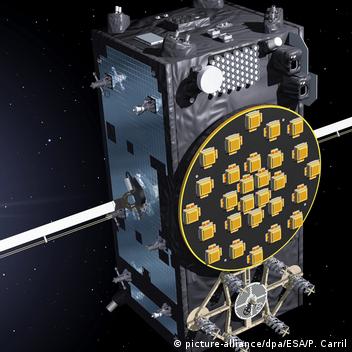
The Austrian Ministry of Defense is poised to make a significant leap in its space security capabilities. Its inaugural satellite, named BEACONSAT, is currently under development by Vienna-based startup GATE Space and is slated for launch aboard a SpaceX Falcon 9 rocket one year from now. This pioneering initiative heralds a new era for Austria’s and Europe’s defense capabilities in an increasingly complex geopolitical landscape.
BEACONSAT: Austria’s Vigilant Eyes on Electronic Warfare
BEACONSAT is no ordinary satellite. Its primary mission is the detection of digital jamming and the collection of pertinent data. Austrian Defense Minister Klaudia Tanner underscored the project’s critical importance, warning of the severe risk of troop disorientation in conflict scenarios. When satellite-based navigation systems (GNSS), vital for land, sea, and air movement, are intentionally or unintentionally disrupted, the consequences can be dire.
Moritz Novak, CEO and co-founder of GATE Space, explained that the satellite will be able to identify both jamming and spoofing of position, navigation, and timing constellations such as the US Global Positioning System and Europe’s Galileo, systems relied upon by both military forces and civilians. These technologies form the bedrock of aviation, autonomous mobility, critical infrastructure, and modern defense operations, highlighting the essential nature of their monitoring.
Strategic Partnerships and „Made in Europe” Innovation
Behind the BEACONSAT project lie collaborative efforts and diverse expertise. GATE Space, a company established in 2022 with an initial focus on rocket propulsion systems, serves as the prime contractor. Its partners include Danish satellite manufacturer Space Inventor and the Austrian firm IGASPIN GmbH, which specializes in developing GNSS interference detection payloads, alongside a network of Austrian subcontractors, thus consolidating a collaborative European approach.
While the total development costs have not been publicly disclosed, the Austrian Ministry of Defense is contributing €1 million, with the European Space Agency (ESA) adding €500,000. ESA’s funding is particularly noteworthy, following a historic shift recently approved by its 23 member states, enabling the agency to support dual-use capabilities that benefit both military and civil activities, opening new horizons for continental security.
European Space Sovereignty: A Strategic Imperative
BEACONSAT transcends being merely a satellite; it stands as a symbol of Europe’s aspirations for greater independence in space. Jan Smolders, chief commercial officer at Space Inventor, emphasized that this mission unequivocally demonstrates the European industry’s capability to independently design, build, and operate advanced defense space systems. BEACONSAT represents a clear manifestation of sovereign European space capacity in action – operationally ready, technologically advanced, and built in Europe, for Europe, a powerful message on the global stage.
Beyond High Orbit: A Dutch-Austrian Vision for Terrestrial Observation
In addition to BEACONSAT, the Austrian Ministry of Defense is collaborating with its Dutch counterpart on an ambitious complementary project: the development of three LEO2VLEO demonstration satellites. These satellites are designed to maneuver between low Earth orbit (LEO, below 2,000 km) and very low Earth orbit (VLEO, between 100-450 km) to provide detailed terrestrial imagery. The use of VLEO, an area with significant atmospheric drag requiring additional propulsion to keep satellites aloft, opens new perspectives.
The LEO2VLEO project, valued at €10 million, is being funded through the European Defence Fund, with the prime contract awarded to ISISPACE. These satellites will provide proof of concept and in-orbit demonstration of defense applications, addressing Europe’s urgent need for sovereign, rapid-response space assets. Utilizing very low Earth orbit offers several significant strategic advantages, including improved communications, enhanced agility, and superior Earth observation capabilities, all while minimizing the risk of space debris, thereby solidifying European presence and security in space.