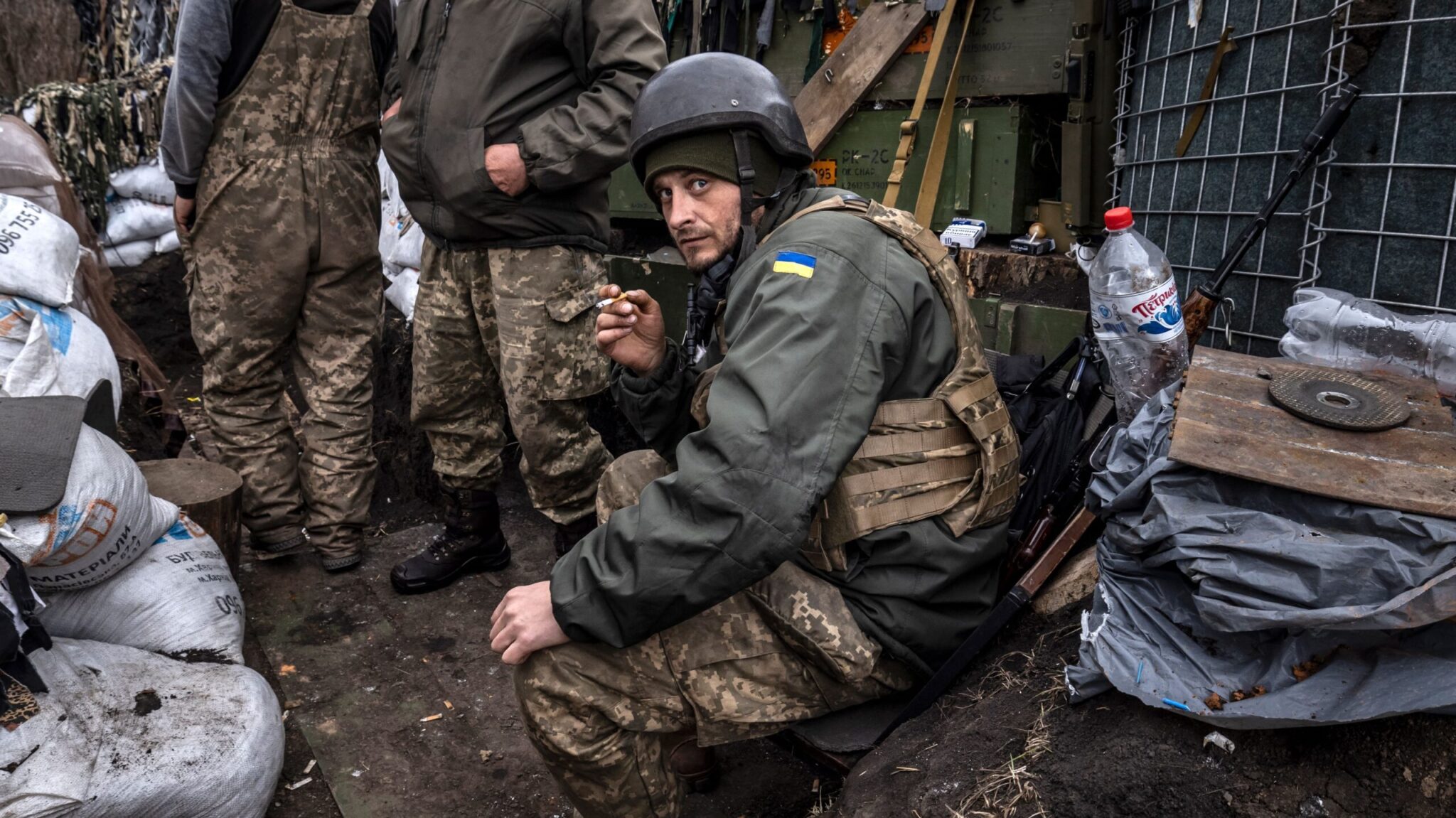
The pronouncements in February 2022 were dire. If Russian President Vladimir Putin decided to invade Ukraine, U.S. analysts and officials thought Kyiv would fall within as little as three days.
But today, exactly 1,000 days after the Kremlin rolled tanks toward the Ukrainian capital, Kyiv is still standing, supporting a war effort deep into the country’s east, where the battle lines have stubbornly settled.
Ukraine’s valiant defense of its land and Russia’s largely inept attempt to take it were certainly welcome surprises in Washington; however, they were surprises nonetheless, indicating a degree of intelligence failure for the 17 organizations within the American Intelligence Community.
The chief of the Defense Intelligence Agency, whose primary mission is estimating the relative might of foreign militaries, stated Thursday that one intangible factor threw off their calculations: the Ukrainians’ “will to fight.”
“The Ukrainians … exhibited a will to fight that was far beyond anything any of us had estimated,” Lt. Gen. Jeffrey Kruse remarked at an event organized by the Intelligence and National Security Alliance, contrasting Ukraine’s resilience with that of the Afghan armed forces, which collapsed as U.S.-led coalition forces withdrew from that Southwest Asian nation.
Kruse, who was the military affairs advisor to the Director of National Intelligence in 2022 and took the helm of the DIA in February 2024, also noted the quality of Russian equipment, the training of individual soldiers, and their willingness to share information within their own organization as factors that the U.S. appeared to have misjudged.
However, it was the “will to fight” factor that seems to have made the biggest impact on the DIA, prompting Kruse to say that his agency is attempting to make the intangible tangible so it can be incorporated into future military power reports.
“And so the team went through and built a ‘will to fight’ all-source tradecraft methodology [to ask] ‘What does that look like? How do we assess what that looks like?’” Kruse explained. He added that this methodology has already been applied to “several militaries,” including the military’s top priority, China, although he did not provide any conclusions from that “will to fight” assessment.
More broadly, Kruse noted that the Chinese military appears to be on track to meet President Xi Jinping’s goal of being able to invade Taiwan within a predetermined timeline if Xi decides to take that drastic step—likely referencing reports suggesting that Xi set 2027 as the deadline for that capability, known as the Davidson Window. However, Kruse expressed skepticism about whether China has a plan for what to do after the invasion—specifically, for actually holding territory, preventing Taiwan’s allies from intervening, and securing its own borders.
“I’m not convinced that [Xi] is in a place to do all those things just yet,” he stated. “So, as you know, we’re working to ensure we [understand] where that is and, where we can, change the calculus for Beijing.”
North Korean Troops in Russia? Back in Russia, Kruse assessed the surprising deployment of North Korean troops to Russian territory, estimating their number to be “north of” 10,000.
This is a significant figure that Kruse suggested might allow Moscow to conduct an effective counter-attack in Kursk, an area currently held by Ukraine. However, he cautioned that the North Korean troops available might not be the best fit for the task at hand.
“These North Korean forces are from the 11th Corps; they’re special operations forces. They’re the best trained within North Korea, but I’m not sure they meet Russian standards,” Kruse stated. “Special operations forces are designed for specific tasks—raids, sabotage, and a variety of operations—but they may not be well-suited to lead a mass conventional counteroffensive.”
Addressing the New Intelligence ‘Multiverse’ Kruse remarked that Russia’s invasion of Ukraine and China’s increasingly aggressive actions in the Pacific are indicative of a “macroshift” he’s observed in recent years, moving from a rules-based framework to one in which more countries are willing to use “raw power” to achieve their objectives.
Moreover, he highlighted another macrotrend in his keynote address: the shift from a unipolar world to a “multiverse.” Kruse clarified that he was not referencing the concept of multiverse as portrayed in the Marvel Cinematic Universe but instead pointed out that the influx of misinformation and disinformation has created “information microclimates”—multiple universes of truth.
“Today’s information environment, increasingly influenced by AI, enables the viral growth of information microclimates that can be really hard to break through or change,” he explained. “Thus, deciphering fact from fiction, which is crucial in the intelligence community to support decision-making and aid warfighters, will be a significant hurdle for the foreseeable future.”