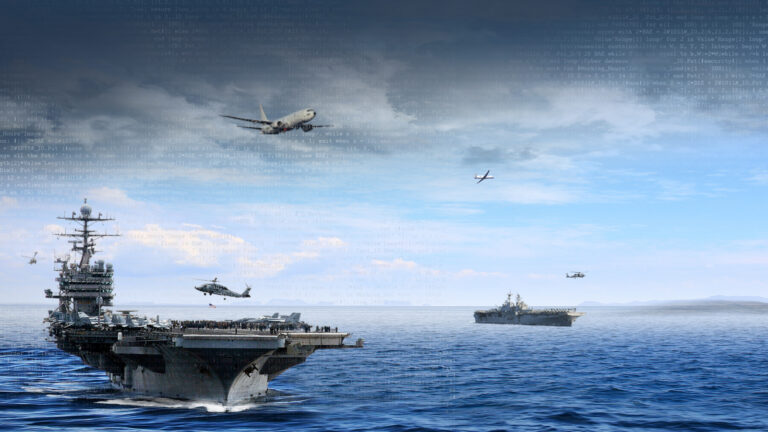
The United States Navy faces a unique challenge: maintaining efficient and secure long-distance communication at sea, without a traditional land-based network infrastructure. This historical limitation has hindered real-time information sharing. However, a new technology, the Network Tactical Common Data Link (NTCDL) system, promises to radically change this landscape.
Overcoming the Barrier of Distance
The NTCDL system, developed by BAE Systems under an $85 million contract, now allows carrier strike groups to share data across a multitude of formats. Unlike previous methods, which permitted communication with only one naval or air asset at a time, NTCDL operators can simultaneously interact with multiple assets across diverse channels. This capability, already deployed on U.S. aircraft carriers, is designed to be scalable and adaptable to various ship classes and sizes.
Unprecedented Innovation: What Makes NTCDL Unique?
Experts describe NTCDL as an unprecedented innovation worldwide. „This is an exciting and much-needed new capability. We are talking about real-time, multi-channel data link communication,” explains a BAE Systems representative. Essentially, the system extends the fleet’s line of sight, providing naval assets with expanded decision space and crucial situational awareness for ship protection and the execution of maritime operations. This multi-channel data link capability represents a major step forward in naval advancement.
Historically, such an approach was difficult to achieve due to technical complexity. A data link, whether wired or over-the-air, has the fundamental role of transmitting and receiving information – voice, text data, or situational awareness summaries. NTCDL elevates this concept to a higher level, enabling the simultaneous exchange of voice, data, imagery, and even full-motion video. This allows decision-makers to get to the core of issues and make real-time decisions.
The Complex Architecture of the Naval „Network”
NTCDL is an elaborate system comprising radios, data links, and antennas, all working together to create an actual communication network. „We like to say NTCDL is the network,” officials emphasize. The system includes all the equipment needed to transmit and receive critical data. In a military environment, protecting this information is paramount, which is why NTCDL is a fully locked system capable of encrypting and decrypting data. A mission software component allows users to command and control the data flow, requesting information from specific assets or transmitting to others.
Tactical Advantage in the Face of Modern Threats
As adversaries become increasingly sophisticated and geographically dispersed, threats have expanded beyond immediate physical confrontations. They now include attempts to disrupt communication and coordination capabilities. Adversaries constantly seek data about the position and actions of naval forces. In this scenario, the Navy requires highly reliable systems with multiple bands, capable of secure anti-jamming for data and image transmission, and fully networked communication. NTCDL ensures data security across multiple channels, countering enemy disruption efforts.
Extending Mission Horizons
This new capability provides the U.S. Navy with a significant advantage, allowing, for example, a carrier group to remotely control an ISR UAS (Unmanned Aerial System) while it monitors targets. „That’s exactly right,” confirms a BAE Systems expert. „This capability enables our forces to extend the ranges of our missions, facilitating longer-range communications, more communications, secure communications, and interactions with manned and unmanned platforms.” NTCDL brings a suite of data transmission capabilities that amplify operational range and efficiency.
The system is also modular and scalable, ready to integrate future waveform evolutions and adapt to the next phase of the military ecosystem.
Concrete Applications: From Anti-Submarine Warfare to Rescue
NTCDL offers 360-degree coverage, essential for various scenarios. This includes, but is not limited to, communicating with high-flying aircraft, rotary-wing aircraft with ISR capabilities for anti-submarine warfare, or search and rescue missions. Full-motion video transmission and real-time communications represent a qualitative leap compared to legacy systems.
The Digital Fortress: Combating Cyber Threats
Regarding cybersecurity, NTCDL is designed as a completely „locked down” system, preventing even insider threats. It operates under strict guidelines of the cybersecurity risk management framework. Every part of the system is secured, distinguishing it from previous generations of common data link systems that merely transmitted data to an existing platform. NTCDL controls data in a manner compliant with the most rigorous cybersecurity standards.
The Future of Naval Communications
NTCDL is a pioneer, providing the Navy with new capabilities that amplify coordinated tactical advantage. Designed for rapid fielding, with ease of upgrades and support for new waveforms, the system will allow operators to use it on both large and small platforms, creating additional networks. The goal is to provide operators better access to surveillance and reconnaissance data and to facilitate the exchange of command and control information across multiple networks. Through NTCDL, all this data is integrated to create a robust and efficient new network.