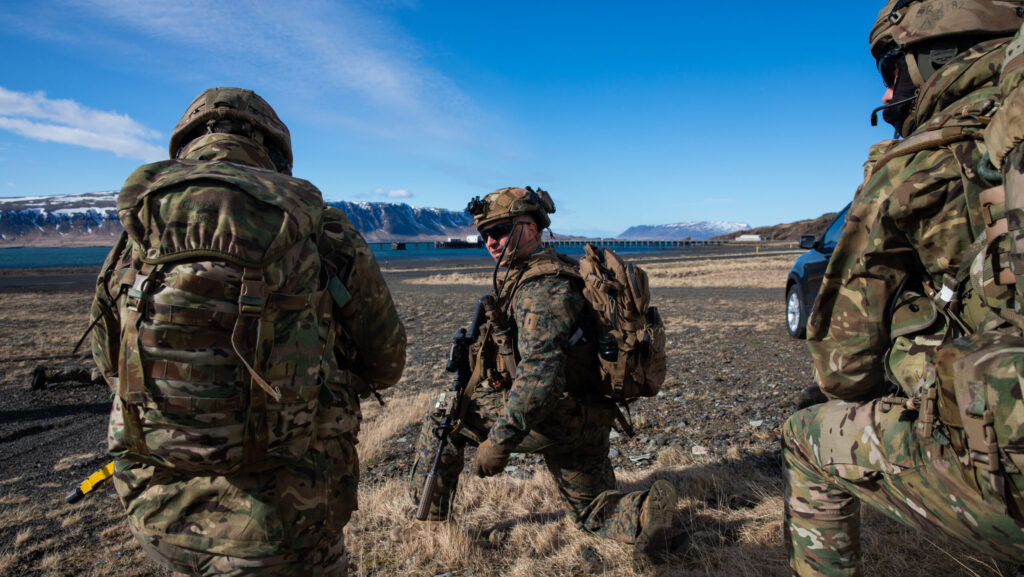
In a harsh, wind-swept landscape at the Icelandic air station the US shut down two decades ago, the echoes of the Cold War feel more present than ever. The gray, hardened concrete aircraft shelters evoke a distinct sense of „Cold War 2.0,” underscoring escalating tensions in a region of critical strategic importance. Here, six Swedish JAS 39 Gripen C fighters, deployed for Arctic air policing, were grounded for two days due to extreme weather conditions—a decision that, paradoxically, was not about the aircraft, but pilot safety.
Grounded by Gusts: Swedish Pilots Navigate Harsh Arctic Conditions
„Hanging in a parachute and crashing into the ground in 45-knot gusting winds — I wouldn’t recommend that,” stated Lt. Col. Robin Arvidsson, a fighter pilot and squadron commander in the Swedish Air Force, illustrating the inherent risks of Arctic operations. Keflavík Air Station, constructed during World War II and serving as a US military base until 2006, has infrequently hosted NATO air policing missions on a rotational basis since 2008.
Now, the Swedish Air Force’s Skaraborg Wing (F7) has its fighter jets deployed at the base, along with over 100 personnel, some of the jets carrying IRIS-T short-range infrared-seeking air-to-air missiles. Sweden holds primary responsibility for securing Arctic airspace for two months as part of NATO’s „Arctic Sentry” mission – a first for the Swedish Air Force.
A Dual Message: NATO’s Arctic Stance Targets Kremlin and Critics Alike
This rotation underscores the alliance’s resolve to defend the Arctic, sending a dual signal to both US President Donald Trump, who has complained about Arctic defense, and to the Kremlin, with its strategic bombers and submarines in the nearby Kola Peninsula.
“Russia is establishing new operations and new bases, and we need to be present in the Arctic,” Major General Jonas Wikman, commander of the Swedish Air Force, affirmed. He added that Sweden has „good knowledge of what’s happening in the area and we are ready to act. So far, we haven’t had any reason for what we call an alpha scramble to protect the airspace.”
NATO’s Command Reshuffle: A New European Hand on the Transatlantic Helm
Since December 2025, all Nordic allies have been under the command of NATO’s Joint Force Command Norfolk (JFC Norfolk). Its area of responsibility spans from North America across the Atlantic to the Russian borders with Finland and Norway, covering the Arctic region and the critical transatlantic link between North America and Europe.
About a month ago, NATO announced a command restructuring plan under which the US will hand over leadership of two key operational-level commands to European allies: JFC Norfolk to the United Kingdom and JFC Naples to Italy. NATO officials indicated that European Allies, including its newest members, „will play a more prominent role” across leadership posts. However, concrete changes are not yet visible, but an increase in the number of British officers is anticipated once a British general or admiral takes over.
“After the change, all those adjustments are going to happen incrementally. When my boss leaves the job, there’s a UK general or admiral taking over. That’s the plan,” confirmed Major General Frode Arnfinn Kristoffersen, Deputy Chief of Operations of JFC Norfolk.
Iceland’s Strategic Awakening: A Demilitarized Nation Embraces Defense
Almost simultaneously with the Swedish Air Force’s arrival for Arctic air policing, Iceland’s parliament, the Althing, adopted the country’s first-ever National Defense Strategy (NSD) on February 3, despite being a NATO member since 1949. As a founding member of NATO, Iceland has never maintained armed forces, a deliberate choice despite no legal barriers. Its inaugural strategy affirms that the country will remain a “demilitarized state” while “actively protecting its sovereignty.”
Following the 2006 departure of US defense forces, Iceland and the United States forged an agreement on “mutual commitments” to guarantee ongoing protection. Icelandic officials then assumed control of key defense zones and Keflavík Airport, with NATO assets such as the air defense network, radar and communications sites, and the command hub within the airport’s secure perimeter. Iceland’s air defense currently relies on four radar stations that monitor airspace to identify and track aircraft movements, with NATO air policing aiming to safeguard the northern flank through continuous real-time surveillance.
The Unseen Threat: Russian Submarines and Critical Undersea Infrastructure
Iceland’s NSD states that Russian vessels “regularly sail where undersea infrastructure is located” in the North Atlantic, and Russia has the capability to “disrupt or even sever the country’s connections to the outside world via undersea cables.” Additionally, Chinese authorities have shown “considerable interest” in the High North for some time, with naval and air forces of Russia and China increasing their cooperation in recent years.
However, the Swedish Air Force says it has not seen much Russian activity in the air domain during their first month of air policing. Iceland’s strategy anticipates attempts by Russia’s Northern Fleet on the Kola Peninsula “to disrupt shipping and troop movements, destroy infrastructure and Alliance capabilities through limited military actions, submarines, or hybrid operations.” It also stresses that control over the sea area between Greenland, Iceland, and the United Kingdom (the GIUK gap) “is decisive for NATO submarine defenses, as Russian Northern Fleet submarines must pass through the gap to reach the southern Atlantic.”
Currently, the US has a detachment of P-8 Poseidon anti-submarine warfare aircraft in Iceland for maritime patrol and reconnaissance, „keeping track of the Russian subs in the waters surrounding Iceland,” stated Lt. Col. Johan Legardt, commander of the Swedish Air Force detachment. The number of American P-8s varies daily, ranging from one to eight, with two currently present. Responsible for the Swedish detachment, Legardt said that Russian long-range bombers on the Kola Peninsula are the „most likely threat… From time to time they occur.” The Russian bombers take off from their bases in Murmansk and are detected by Finnish and Norwegian radars, thus ensuring „very good situational awareness.”
US Continues to Anchor North Atlantic Security Amidst Broader Allied Engagement
Despite a European push to become less dependent on Washington, Iceland’s first National Defense Strategy concludes that the United States “is the only country with the capacity to adequately ensure security in the North Atlantic.” There are about 200 to 300 US military personnel in Iceland, depending on the number of aircraft operating there, Director General Jónas G. Allansson, Iceland’s chief of defense, stated. “So we are working very closely with the US on this.”
He stressed that much of the activity at the air base has been developed to support the anti-submarine warfare (ASW) mission. “It’s not only the US. We have Norwegian airplanes coming in. The UK is common here. Germany has just invested in new P-8s. So we want to be a part of the ASW ecosystem that is developing in the North Atlantic,” Allansson explained.
Despite having no military and traditionally being exempted from standard NATO defense spending targets, Iceland “cannot be exempt from Alliance demands for increased funding,” the NSD states. The nation, which describes itself as a demilitarized zone, affirms that “it must meet” NATO’s 1.5 percent benchmark for “defense-related expenditures.” However, neither parliament nor the government has said anything about a timeline for reaching that goal, nor have they specified how Iceland could relate to NATO’s target for 3.5 percent core defense spending in the future.
Beyond the Alliance: Iceland Forges New Security Partnerships
Instead, this small Arctic nation has stepped up defense ties to the UK-led Joint Expeditionary Force, whose headquarters are in Northwood, and bilateral cooperation with key neighbors such as Denmark, Finland, France, Canada, Norway, and Sweden. Similar agreements with Germany and the European Union are in preparation, while existing pacts with Sweden, Norway, and Canada are set to be updated amid the evolving security environment, the NSD concludes.