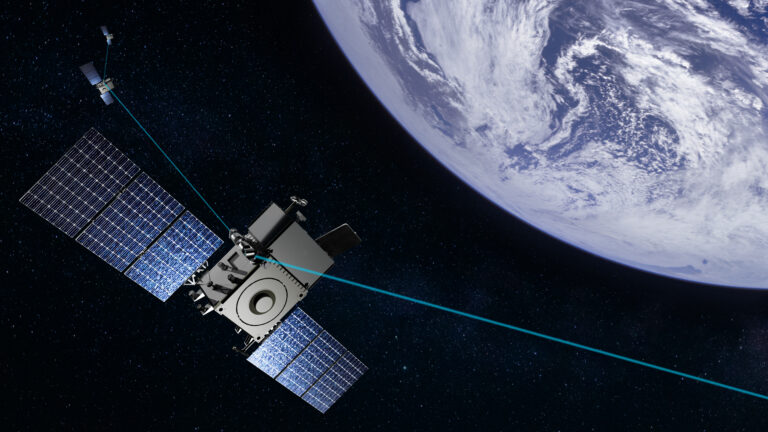
In a significant strategic move, the United States Space Force has awarded Kratos Technology and Training Solutions a contract worth up to $446.8 million. This pivotal agreement focuses on building the critical ground system for the service’s new medium Earth orbit (MEO) constellation, a sophisticated network designed to detect and track ballistic and hypersonic cruise missiles, thereby bolstering national defense against advanced threats.
Laying the Technological Foundation for Space Defense
Kratos will play a central role in supporting the launch and operations of the first two iterations of the Space Force’s Resilient Missile Warning Tracking (MWT) architecture in MEO, dubbed „Epoch 1” and „Epoch 2.” Formalized on March 17 under a Ground Management and Integration (GMI) Other Transaction Authority (OTA) agreement, the Kratos contract will encompass managing operations at a corresponding ground-based Space Operations Center.
This award to Kratos serves as a continuation and expansion of an initial $55 million task order granted to Parsons Corporation in April 2023. The earlier contract aimed to develop hardware and software solutions and equip the Space Operations Center for an initial Epoch 1 launch capability. The new agreement solidifies and extends this support for Epoch 1, Epoch 2, and future MEO space vehicle (SV) launches and operations already under development and production, as well as future SVs, contributing decisively to a robust and resilient MWT architecture.
Architecting a Constellation of Vigilance
The Space Force is planning a baseline constellation of approximately 30 Resilient MWT MEO satellites. Orbiting at an altitude between 2,000 kilometers (1,242.7 miles) and 35,786 kilometers (22,236.4 miles) – positioned between low Earth orbit (LEO) and geosynchronous orbit (GEO) – MEO offers a strategic vantage point for continuous and effective surveillance. This ambitious program is one of three distinct missile warning/tracking efforts managed by the service, all supporting the strategic „Golden Dome” initiative.
The Dynamic Path of Satellite Development
The constellation’s development has not been without its share of challenges and adjustments. In January 2023, the Space Force awarded contracts to Raytheon Intelligence & Space and Boeing’s Millennium Space Systems to build Epoch 1 prototypes. L3Harris Technologies secured a $29 million contract in June 2023 for Epoch 1 sensor payload design.
However, by June 2024, Raytheon was removed from the program due to technical failures and significant cost and schedule overruns. Consequently, in October 2024, Millennium Space Systems received an additional $386 million to provide six more satellites, bringing the total for Epoch 1 to 12 birds. Looking ahead, BAE Systems was awarded $1.2 billion in June 2025 to construct 10 satellites for the second-generation Epoch 2.
Future Horizons: A Phased Launch Schedule
The launch calendar is already set, marking essential milestones in strengthening American space defense. The first set of nine Epoch 1 satellites is slated for launch early in calendar year 2027. A second set of Epoch 1 satellites is anticipated for delivery in fiscal year 2028, with the first of the next-generation Epoch 2 satellites expected in FY29. These advancements underscore the Space Force’s firm commitment to modernizing and expanding its missile warning and tracking capabilities in an ever-evolving global security landscape.