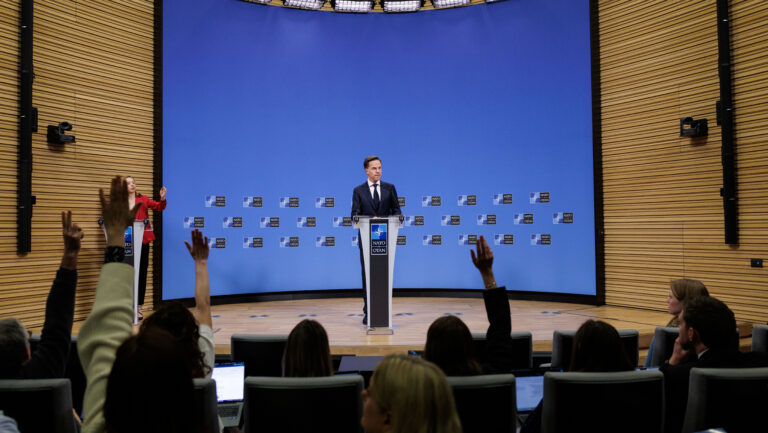
North Atlantic Treaty Organization (NATO) officials have identified a substantial shared requirement of up to $145 billion for munitions and air defense systems across its member-states. This colossal figure, detailed in the Alliance’s Annual 2025 Report released this week in Brussels, underscores the urgency with which Secretary General Mark Rutte is poised to make weapon production a top priority at the upcoming NATO summit.
Record Figures: An Unprecedented Financial Commitment
The $145 billion figure, equivalent to approximately €125.9 billion, represents the aggregated demand for missiles, bombs, drones, and deep precision strike systems. These numbers are a result of NATO’s Reoccurring Process for Aggregating Demand (REPEAD), which pools countries’ capability needs. The Alliance is now working closely with allies and the defense industry to meet these requirements „as quickly and economically” as possible. For the 2025 cycle, the focus will shift to maritime battle-decisive munitions, intelligence and surveillance capabilities, and selected land domain requirements.
The 2% Benchmark Reaches a Historic Milestone
A significant revelation from Secretary General Rutte is that last year marked the first time all NATO countries met or exceeded the 2 percent of GDP benchmark for defense spending. Rutte largely attributed this achievement to the relentless pressure from the previous American administration to end what he termed „free-riding” by allies. While Washington still accounts for a majority (60 percent) of NATO nations’ defense spending, European and Canadian contributions rose by 20 percent, boosted by an additional $94 billion from the previous year. This trend indicates a clear shift in investment priorities towards the procurement, research, and development of new weaponry, contrasting with earlier periods when the bulk of spending was dedicated to personnel and operations.
European Munition Stockpiles: Concerns and Concrete Actions
Amidst these financial commitments, cautionary signals have also emerged from the industry. Armin Papperger, CEO of Rheinmetall, recently stated that despite years of warnings, European, American, and Middle Eastern munition stockpiles were „nearly empty” due to ongoing conflicts. While these remarks contrast with some findings in the NATO report, which suggest that increased spending would allow for a rapid expansion of munition manufacturing, Rutte acknowledged the underlying concerns.
The Secretary General conceded that this issue will be a central focus at the next NATO summit. He highlighted that, while there is „good news”—munition production has increased sixfold compared to a couple of years ago—it is clear that „there is still more to do,” as the defense industrial base is simply not producing enough. Rutte emphasized that this difficulty represents a shared vulnerability, affecting the United States, Canada, and Europe alike. He mentioned high-level meetings with key American suppliers and European leaders to address the issue. Such calls for increased production are not new, having peaked in 2023 when Western militaries struggled to replenish their munition stockpiles, particularly artillery ammunition, due to supplies being sent to support Ukraine. NATO is now demonstrating a firm resolve to translate these challenges into concrete actions to ensure a robust defense for all its members.