A recent industry call from the United States Army, which could dramatically reshape its quest for a Bradley replacement, signals a new era in military acquisitions. A senior Army official indicates that more such initiatives are on the horizon, as the service actively reviews its longstanding ground vehicle portfolio programs.
Accelerating Acquisition: Speed and Adaptability at the Forefront
„If you look at how quickly things are changing, from a technology perspective, who is actually interested in this defense space that is constantly evolving and changing, I think we’re doing ourselves a disservice if we only wait every five years to take a look at the market,” explained John Jolokai, executive director and senior contracting officer for Army Contracting Command – Detroit Arsenal. This statement underscores a fundamental paradigm shift, moving from lengthy development cycles to a continuous pursuit of innovative solutions.
Last month, the Army issued a Request for Information (RFI) to industry, seeking „innovative solutions for the rapid design, production, and delivery of ground combat vehicles.” The RFI specifically targeted tracked vehicles weighing 40 to 80 tons and outlined an aggressive timeline, including the potential acquisition of 10 prototypes later this year and „continuous production” of up to 2,500 vehicles annually.
The Bradley Replacement Dilemma: Re-evaluation or Reinforcement?
While the RFI did not explicitly mention the XM30 Mechanized Infantry Combat Vehicle program, the designated successor to the Bradley, industry sources and analysts suggested it could signal the Army’s willingness to reexamine the program and explore potential alternatives.
„We are actively assessing multiple, competing designs for the XM30 to foster a truly competitive environment,” Army spokesperson Maj. Pete Nguyen stated on February 27. „We continue to look for partners who can deliver cutting-edge solutions now, not decades from now. This is a deliberate and necessary step to ensure we assess and select the best approach to deliver a world class vehicle today and into the future.”
However, executives from companies currently involved in the XM30 program remain confident. A senior executive at American Rheinmetall, who is working on the program alongside General Dynamics Land Systems, expressed he is „not too concerned” about the RFI, stating the company is on track to deliver two prototype vehicles to the Army this summer. „I took those comments to mean the Army is always looking for alternatives and options, so I’m not too concerned, because I don’t really think there’s anybody out there who’s got a system that’s as far along as what both us and General Dynamics have spent the last several years designing,” said Jim Schirmer, senior vice president of sales and marketing. An executive from GDLS also confirmed that business is proceeding as usual, with prototypes to be delivered on schedule.
The „Common” Tactical Truck: Unity or Diversity?
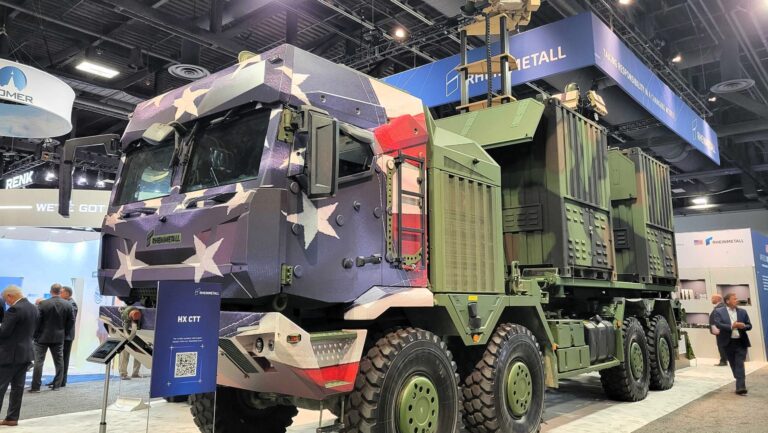
Other programs are also under scrutiny within this re-evaluation framework. Jolokai pointed to a recent commercial solutions opening (CSO) for the Army’s Common Tactical Truck (CTT) program – the service’s effort to modernize its Heavy Tactical Vehicle Fleet, which will replace the Palletized Load System, the Heavy Expanded Mobility Tactical Truck, and the M915 Line Haul Tractor.
Commercial solutions had previously been sought, and in 2023, OshKosh, Mack Defense, American Rheinmetall, and Navistar Defense were awarded Other Transaction Authorities (OTAs) to develop prototypes. However, in September, the Army announced it would not proceed with a final Request for Proposal (RFP) for the CTT, providing no specific reasoning.
An Army spokesperson recently explained that the shift to a CSO model will accelerate the CTT’s acquisition timeline. „The Army intends to leverage commercially available solutions to deliver capabilities to the warfighter more quickly. This shift in acquisition strategy allows us to capitalize on industry strengths,” the spokesperson clarified. This change could also mean the Army procures more than one type of CTT for the six different mission areas the truck is expected to fulfill, a departure from the service’s original request for a single vendor.
„While ideally we would have the same vendor for a Common Tactical Truck across all six variants, we have given ourselves room, and we’re inviting industry to tell us, ‘Hey, I really think my sweet spot are these two of the six variants, right, or this one, or all six, right?’” Jolokai added.
However, awarding multiple variants might dilute the „common” aspect of the CTT, as warned by Schirmer. „If you want a common tactical truck that has the same engine, transmission, suspension, etc, across that family, you’re going to get more than you need for some missions in order to get enough for the ones that are the hardest. If they’re going to break that up and award different companies based on who’s optimized, it’s not going to be common. That’s okay. That’s an approach.”
A recently posted acquisition notice confirms „Multi-vendor consideration” and states that „Program quantities may be divided among multiple vendors if multiple contracts are awarded.” The notice further indicates that the Army is seeking an initial projected quantity of 758 systems over five years, contingent on available funding. This strategic maneuver underscores the US Army’s commitment to rapidly adapt to the evolving technological landscape and equip its forces with the best available equipment, even if it means rethinking long-standing acquisition paradigms.