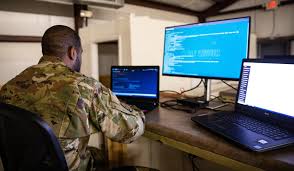
In a significant stride towards bolstering American cyber security, Sealing Technologies, a subsidiary of the industry giant Parsons, has commenced the delivery of the first batches of its next-generation defensive cyber kits to elite units. This innovative solution, known as the Joint Cyber Hunt Kit (JCHK), is poised to transform how US Cyber Command (CYBERCOM) operators conduct essential „hunt” missions, including critical „hunt forward” deployments on foreign partner networks.
Revolutionary Equipment in Detail
Designed for extreme portability and efficiency, JCHK kits are the size of a standard suitcase, allowing them to be easily stored in overhead compartments on airplanes. This portability enables CYBERCOM’s defensive SWAT teams to respond directly to intrusions onsite—a crucial capability for networks that cannot be remotely monitored or are disconnected from wider external infrastructures, including those of international partners. The kit boasts significantly improved storage capacity, increased speed, and, for the first time, integrates advanced artificial intelligence capabilities for rapid identification and analysis of network threats.
Hunting Advanced Threats and Remediation
According to Mike Kushin, President of Defense and Intelligence at Parsons, the primary objective of these kits is the detection and neutralization of Advanced Persistent Threats (APTs)—sophisticated attacks, often attributed to nation-state actors, which are notoriously difficult to identify. „Hunting is for really the [advanced persistent threats] that are pretty hard to find, because they’re pretty sophisticated, usually [from] nation states,” Kushin stated. While the kits provide mechanisms and methods for remediation, the primary responsibility lies with the operational teams, working in close collaboration with CYBERCOM.
Standardization: The Key to Operational Efficiency
One of the most profound benefits of the JCHK is the introduction of standardized equipment for CYBERCOM’s defensive teams. Historically, the absence of a unified approach led to significant variances across different services, with each outfitting cyber units in slightly different ways. This inconsistency generated inefficiencies in terms of kit, training, funding, and operations and maintenance. With the adoption of JCHK, a substantial increase in efficiency across the entire force is anticipated. Kushin emphasized that „the commonality will help with the [operations and maintenance] tail, so the government can focus more money on hunting and the tech advancements over the course of the next three years, whether it be performance or elsewhere, as opposed to O&M tail and having all these non-common units out there.”
Expanding the Horizon of Cyber Defense
The rollout of the JCHK follows an initial low-rate production contract that called for the delivery of a dozen sets to high-priority units. In February, a full-rate production contract worth up to $500 million over three years was announced, with Parsons committing to deliver 74 units this calendar year alone. Interest in these kits already extends beyond CYBERCOM, with inquiries from other Department of Defense components and federal agencies, such as CISA. The overarching goal remains the promotion of a common platform to the maximum extent possible, deemed beneficial for both users and the equipment delivery process.