Breaking the Mold: Engineering a New Era of Firepower
Ten years ago, conventional military wisdom dictated that the United States Army would be a bystander in a potential conflict with China. It was assumed that tanks and infantry would find no footing in a theater destined to be dominated by the Air Force and Navy. As of 04/17/2026, that narrative has been dismantled. Through a relentless campaign of reorganization and a pivot toward long-range precision fires, the Army has secured a decisive role in the Pacific, proving it can strike deep into enemy territory from staggering distances.
The shift began in 2018 with the establishment of Army Futures Command, an entity designed to answer a single question: How does the Army fight in the Pacific? Backed by strategic analyses, the service prioritized holding high-value targets—C2 sites, airfields, and missile batteries—at risk. The subsequent creation of „PAE Fires,” led by a three-star general, ensured that these new offensive and defensive capabilities reached the field without becoming mired in traditional bureaucratic gridlock.
Hypersonics and Integration: The High-Tech Chessboard of Asia
The Army’s technological resurgence is centered at Joint Base Lewis-McChord, where the 1st Multi-Domain Task Force (MDTF) is operationalizing the next generation of warfare. Key to this arsenal is the Long-Range Hypersonic Weapon (LRHW), capable of delivering precise conventional warheads at hypersonic speeds. Complementing this is the Typhon system, a versatile platform that fires Tomahawk cruise missiles and SM-6s, effectively turning ground units into maritime and strategic strike threats.
At the core of this lethal network lies the Integrated Battle Command System (IBCS). This decision-support tool integrates sensors and shooters across US and allied forces, a capability that proved revolutionary during Operation Epic Fury. By optimizing interceptor usage, systems like IBCS coupled with Patriot (PAC-3) batteries effectively double the magazine depth of defensive positions. This allows the Army to establish its own Anti-Access/Area Denial (A2/AD) bubbles, creating safe havens from which coalition forces can strike and maneuver.
The Forward Presence: Piercing the A2/AD Bubble Before Conflict Begins
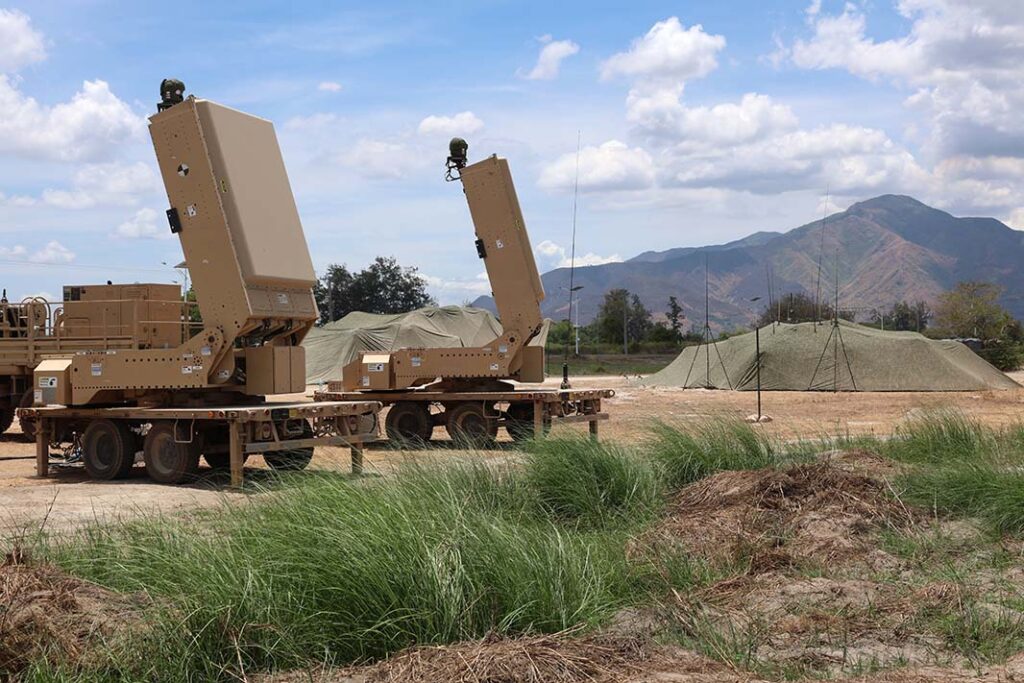
The defining characteristic of the new Army strategy is „pre-positioning.” By deploying mobile shooters like the Typhon system to the Philippines and Japan well ahead of any potential hostilities, the Army avoids the logistical nightmare of flowing forces into a contested theater during a crisis. This forward posture ensures that Army units are combat-relevant from the very first second of a conflict, bypassing the adversary’s air defenses.
Once established in-theater, these units serve a triple purpose: intercepting missile threats, engaging enemy fleets, and conducting strategic strikes on the mainland. However, maintaining this edge requires sustained political will. The fiscal 2027 budget request, totaling $1.5 trillion, proposes quadrupling the procurement of the Precision Strike Missile (PrSM). For the US to truly deter aggression in the Western Pacific, Congress must now ensure that stockpiles of PAC-3s, THAAD systems, and LRHWs are robust. The transformation is complete; the focus must now turn to the industrial scale required to win.