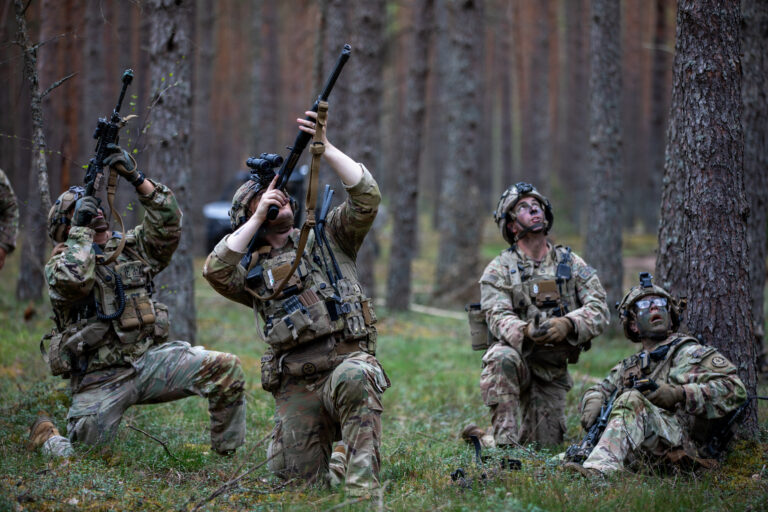
Drawing from the brutal realities of the Ukrainian battlefield, U.S. soldiers are sharpening their senses. In the modern theater of war, a distinct buzz is no longer background noise—it is a lethal signal that requires split-second identification and reaction.
A Vertical Shift: Training Eyes and Ears for the Modern Sky
The era when a soldier’s focus was limited to the 12 o’clock position at ground level is officially over. During the recent Project FlyTrap 5.0 exercise in Lithuania, tactical focus shifted toward a new command: „scan up and out.” This change reflects a profound evolution in patrolling, where the atmosphere above has become as contested and dangerous as the terrain below.
Troops are no longer just looking for movement; they are listening for it. The exercise highlighted that auditory detection is often the first line of defense, providing a crucial warning window before a low-cost unmanned system enters a soldier’s line of sight.
Deciphering the Buzz: Identifying Threat Profiles by Sound
Mastering the „language” of drones has become a critical survival skill. Soldiers are learning to distinguish between various aerial threats based on their acoustic signatures. A high-pitched, rapid buzzing often signals a one-way attack drone accelerating toward its objective. In contrast, reconnaissance assets typically emit a flatter, more consistent hum as they hover at higher altitudes to conduct surveillance.
While this auditory training is not yet a formal part of the standard military curriculum, field experiences on NATO’s eastern flank are filling the gap. The goal is to build visceral muscle memory: when the alert for an aerial threat is given, troops must instinctively hit the ground and aim upward. In this environment, identifying the sound of a drone is the difference between neutralizing a threat and becoming a casualty.
The Ukrainian Blueprint: From Acoustic Networks to Total Awareness
The conflict in Ukraine has provided a masterclass in using passive acoustic sensor networks to counter aerial saturation. By integrating low-cost directional microphones with localized computing power, military units can classify and track incoming drones through time-synchronized data. This system cues ground-based shooters and small air defense teams to neutralize threats long before they reach their targets.
Strategic recommendations now urge U.S. and NATO leadership to adopt and scale this approach across the eastern flank. By combining human sensory training with networked acoustic technology, military forces can create a comprehensive defense architecture. In the current landscape of drone-heavy warfare, the ability to hear the enemy coming is not just an advantage—it is the cornerstone of modern resilience.