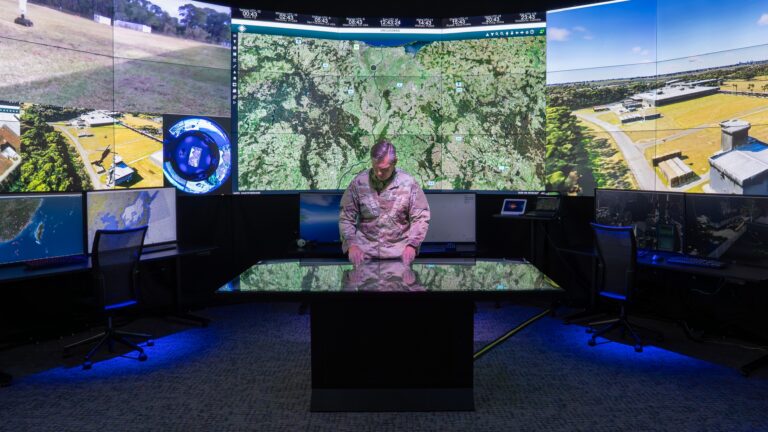
Europe stands at a decisive security crossroads, where NATO’s effectiveness hinges on the seamless integration of its 32 member states. While tactical coordination has evolved, a significant gap remains in the simulation and experimentation layer. Currently, allied nations grapple with legacy tools and siloed data, a fragmentation that poses a risk in an era of rapid technological shifts and hybrid warfare.
Shattering Silos: A „Plug and Play” Arena for Multi-Domain Operations
To bridge this gap, Lockheed Martin’s Advanced Center for Experimentation and Simulation (ACES) offers a unified modeling platform designed to synchronize assets across air, land, sea, cyber, and space. Utilizing an open architecture, ACES allows multinational forces to integrate their existing or newly acquired simulation tools into a single virtual battlespace.
This dynamic federation enables allies to contribute live or synthetic models in real-time. By providing scenario-authoring tools in a shared workspace, ACES streamlines joint exercise planning, allowing multinational staffs to adjust force compositions or rules of engagement and evaluate the results within minutes, dramatically shortening the planning-to-execution cycle.
Anticipating the Unthinkable: „What If” Analysis and Digital Twins
One of the platform’s standout features is its ability to conduct high-fidelity predictive analysis. Decision-makers can virtually insert emerging threats—such as hypersonic weapons and autonomous drone swarms—alongside legacy hardware. This allows for a quantifiable assessment of force-level impacts before a single physical asset is committed.
Commanders benefit from a real-time „digital twin” of the operational theater, where live sensor data is overlaid with simulated adversary maneuvers. This capability not only enhances situational awareness but also enables lifecycle cost modeling, linking battlefield performance directly to logistics and sustainment strategies.
The Collective Edge: Accelerating Readiness Through Integration
ACES transforms training by merging live, virtual, and constructive elements into one cohesive platform. In a multinational exercise, ground troops, simulator-based pilots, and naval assets can all interact within the same defined threat environment. Commanders can run, pause, and replay scenarios to refine joint performance, ensuring that lessons are learned in safety before missions begin.
By providing a shared strategic „sandbox,” ACES accelerates the loop between initial concept and field deployment. This common language of simulation reinforces NATO doctrine and builds vital trust among partners. As the global security landscape grows more complex, operationalizing such integrated platforms ensures that the Alliance’s collective defense remains sharp, adaptable, and technologically superior.