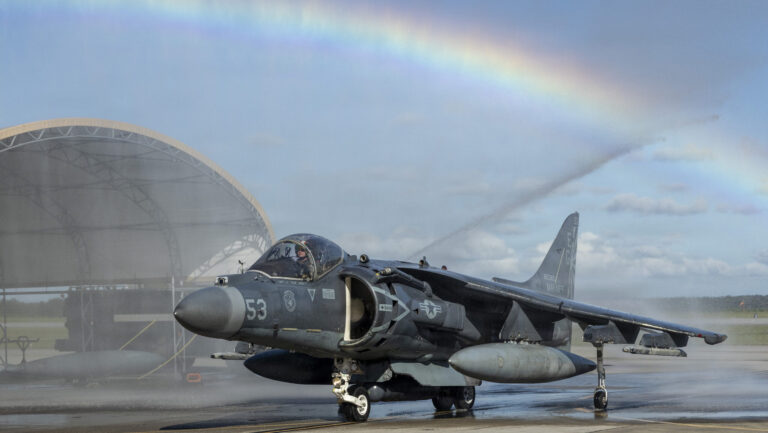
Today, at Marine Corps Air Station Cherry Point in North Carolina, the final chapter was written in the history of one of the Marine Corps’ most iconic combat aircraft. The AV-8B Harrier II completed its final flight as part of a „sundown” ceremony, concluding a storied career of more than 40 years in active military service.
Sunset of a legend at Cherry Point: Emotional ceremony marks the final flight
Today’s ceremony featured a dramatic flyover by five Harriers, providing one last demonstration of the short takeoff and vertical landing capabilities that defined this aircraft. Despite the scheduled retirement, these jets remained highly active until their final weeks, proving their reliability until the very end.
The last operational Harriers belonged to Marine Attack Squadron 223 and recently returned from a ten-month deployment with the 22nd Marine Expeditionary Unit. During this final tour, they supported strategic operations within the US Southern Command, contributing to the naval buildup and regional efforts that preceded major political shifts in Venezuela earlier this year.
Transitioning to the fifth generation: Veteran personnel move to the F-35B
The retirement of the Harrier is a significant milestone in the Tactical Aircraft Transition Plan, as the Marine Corps moves toward a fleet entirely composed of fifth-generation aircraft. The vast expertise of the aircrews and maintenance personnel who operated the Harrier II will be preserved, as they transition to other platforms, primarily the F-35B.
According to the 2026 Aviation Plan, efforts are already underway to preserve the aircraft’s legacy in museums across the United States. This ensures that future generations can appreciate the technology that revolutionized ground attack missions and vertical flight.
A career defined by innovation: From early carriers to modern theaters of operation
The Harrier’s history with the Marine Corps began in 1971 with the AV-8A, followed by the upgraded AV-8B Harrier II in 1985. Its unique versatility allowed it to deploy from traditional carriers as well as smaller maritime platforms, expeditionary airfields, and remote tactical landing sites.
After decades of providing critical air support in numerous conflicts and peacekeeping missions, the Harrier II concludes its service, leaving behind an unmatched reputation for operational flexibility. While the skies will now belong to newer stealth technologies, the „jump jet” has secured its permanent place in military history.