The Collapse of the Centralized Model and the Fragility of Supply Chains
For decades, the global defense industrial base was optimized for efficiency through centralization, concentrating manufacturing in a handful of specialized facilities. That era is coming to a close. Today, geopolitical instability and supply-chain disruptions are forcing a radical rethink. The challenge for modern defense organizations is no longer just mass production; it is the ability to manufacture at the speed of relevance and at the point of need. In an increasingly contested world, operational resilience depends on moving production away from vulnerable, centralized hubs.
Bridging the Gap: From Prototyping to Industrial Performance
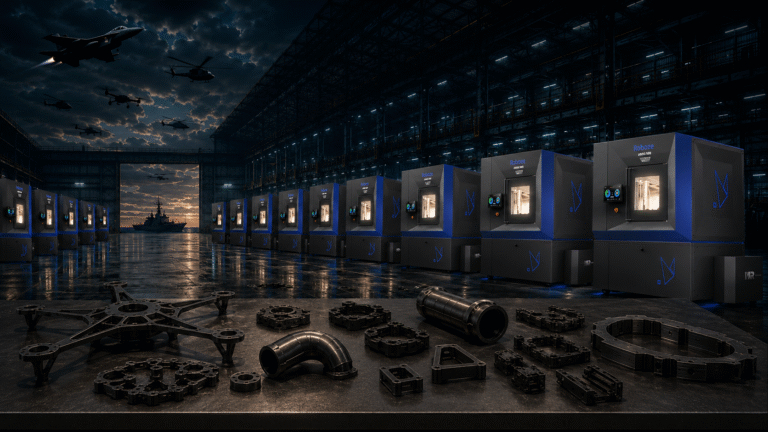
While additive manufacturing has long been a buzzword, it has historically been confined to low-volume prototyping. That paradigm is shifting as companies like Roboze move the technology into a mature, industrial phase. By combining high-performance polymers and advanced composites—such as ULTEM 9085 and Carbon PEEK—with sophisticated process-control software, the industry can now produce mission-critical parts that meet stringent aerospace standards. These materials offer a lightweight, corrosion-resistant alternative to traditional machined components, with the crucial advantage of being repeatable across multiple operational environments.
Manufacturing as Strategic Infrastructure: The Rise of Digital Inventories
Future industrial power will not be measured by the size of a factory, but by the strength of its software-defined production networks. This model treats manufacturing as strategic infrastructure, allowing qualified parts to be produced consistently across distributed geographies. For defense OEMs and military organizations, this means transitioning to secure digital inventories. Instead of waiting months for a component to ship across oceans, parts can be manufactured locally, near the operational theater, effectively decoupling military readiness from the vulnerabilities of global logistics.
Securing Sovereignty: Expeditionary Manufacturing and Strategic Growth
The shift toward decentralized production is already gaining institutional momentum. Initiatives like the DIANA project, co-funded by the Italian Ministry of Defence, are pioneering secure digital frameworks to reconstruct and produce spare parts directly in naval environments. Furthermore, significant investments from key figures like retired Admiral James “Sandy” Winnefeld Jr. highlight the strategic importance of these capabilities within the U.S. defense ecosystem. The next generation of defense manufacturing will be defined by its autonomy and adaptability, turning repeatable, localized production into a pillar of national sovereignty and battlefield superiority.