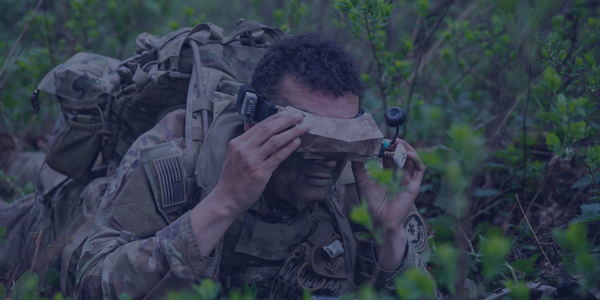
Artificial intelligence (AI) is rapidly becoming an essential part of defense operations, accelerating planning, intelligence analysis, decision support, and operational coordination. As AI becomes more embedded in command-and-control workflows, protecting the growing volume of stored mission data is becoming a critical operational requirement for mission success.
The massive scale of AI adoption: A surge that redefines battlefield operations Defense officials report that AI use across the Department of War increased by 1,775% over the past year, growing to approximately 1.42 million users. Leaders have described this shift as an effort to embed AI into defense systems so warfighters can make faster, more precise decisions. As AI moves closer to real-time battlefield environments, sensitive data will increasingly reside on systems, creating new security and data protection challenges.
Securing data at the edge: The challenge of protecting information in distributed environments For defense teams, a central issue is whether data-at-rest security can be deployed wherever mission data lives. In distributed environments, deployment is not just an operational concern; it is a security requirement. If mission data protection cannot be deployed, updated, recovered, and audited at scale, coverage will be uneven, creating risk across the entire mission data footprint.
Critical hurdles for defense teams: Managing volume, mobility, and residual risks As AI adoption grows, defense teams face several practical data protection challenges:
- Increased data volume: AI systems process and generate vast amounts of imagery, intelligence reports, and targeting information.
- Expanded storage footprints: Sensitive data moves frequently across laptops, tactical systems, and edge devices.
- Offline security requirements: Devices must remain secure even when powered off or exposed outside controlled facilities.
- The need for scalable deployment: A security architecture only reduces risk if it can be sustained across all active systems.
- Residual data risk: Mission data remaining on systems after use creates exposure if devices are captured or retired without proper destruction.
The dual-layer defense model: Combining hardware and software for maximum security For classified environments, experts recommend a framework using two independently implemented layers of protection. The outer layer typically uses hardware full drive encryption paired with pre-boot authentication, protecting data before the operating system even loads. The inner layer adds software-based encryption, which can be rapidly deployed to existing systems in the field, providing defense-in-depth and separate cryptographic enforcement.
Beyond deployment: Ensuring data sanitization and lifecycle control in the quantum era Data protection does not end when a device is deployed. Defense teams also need lifecycle control, including updates, policy enforcement, and secure sanitization. As quantum-era concerns increase the focus on long-term confidentiality, secure sanitization helps reduce future exploitation risk by ensuring sensitive data is no longer recoverable when systems are retired, repurposed, or exposed to emergency conditions. Modernization and data protection must advance together to ensure AI readiness.