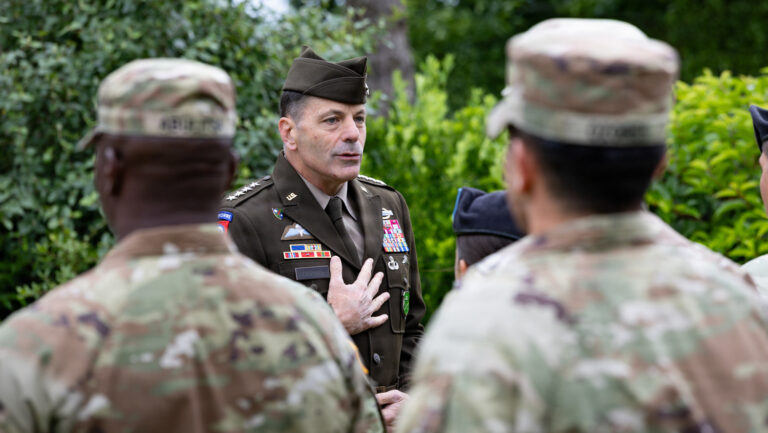
In a move that has sent ripples through military circles on both sides of the Atlantic, General Christopher Donahue, the top U.S. Army general in Europe, is set to relinquish his command next week. His departure, officially scheduled for July 2, 2026, comes after less than two years in the role and marks the latest high-profile exit of a senior officer under Defense Secretary Pete Hegseth’s tenure.
Donahue, who currently leads U.S. Army Europe and Africa as well as NATO’s Allied Land Command, will hand over his duties to his deputy, Major General Christopher Norrie. While the service issued a formal statement of gratitude for his leadership, the sudden nature of his exit has fueled intense speculation regarding a fallout with the Pentagon’s leadership.
Military bureaucracy under fire: Secretary Hegseth’s drive to cut the top brass
The removal of General Donahue appears to be part of a broader, more aggressive strategy to overhaul the military hierarchy. Secretary Pete Hegseth has signaled a firm intention to significantly curtail the number of general and flag officer billets, aiming to streamline command structures and reduce what he views as bureaucratic bloat at the highest levels of the armed forces.
Reports suggest that combatant commands are expected to submit recommendations next week on how to comply with these downsizing mandates. The timing of Donahue’s departure, a four-star leader in a critical theater, indicates that the strategic command for Europe and Africa may be among the positions slated for a potential downgrade in rank or scope as part of this sweeping reform.
A legacy of frontline leadership: From Delta Force to the final exit from Kabul
Christopher Donahue leaves his post with a legacy forged in the most demanding combat environments. A 1992 West Point graduate, he served as a commander in the elite Delta Force before taking the helm of the 82nd Airborne Division. He achieved historical recognition in 2021 as the final American soldier to board a transport plane out of Kabul, symbolizing the end of the two-decade-long war in Afghanistan.
During his tenure in Europe, Donahue was instrumental in reinforcing NATO’s Eastern Flank against Russian aggression. He also spearheaded critical modernization initiatives, such as Project Flytrap, which aimed to revolutionize drone and counter-drone capabilities within the theater. His exit marks the loss of a seasoned operational commander at a time when technological adaptation on the battlefield remains a top priority for the alliance.