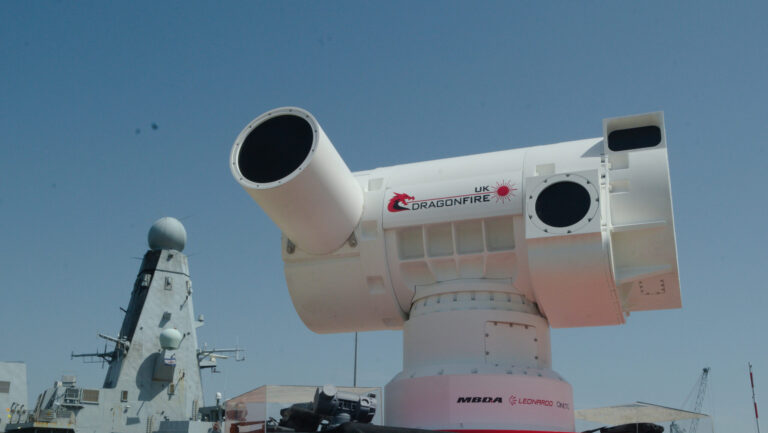
A trio of British industry leaders is exploring ways to shrink the footprint of a cutting-edge high-energy laser destined for the Royal Navy’s Type 45 destroyers. The DragonFire weapon system, a collaborative effort between QinetiQ, MBDA, and Leonardo, represents a paradigm shift in military technology, promising to deliver pinpoint accuracy at the staggering low cost of less than £10 ($13) per shot.
As new test and evaluation phases focus on miniaturizing the hardware, the project remains on track for its first operational deployment by 2027. This timeline positions the United Kingdom to become the first European NATO nation to field directed-energy weapons in a real-world naval environment.
Shrinking the beam: The engineering challenge of miniaturizing laser power
The current phase of development is centered on refining the manufacture of the laser beam and reducing the overall scale of the modular system. Engineers are working to understand the long-term support requirements for such a novel weapon while ensuring the sensitive optical components are protected from the high seas.
Rather than focusing on a specific size target, the priority remains „minimum deployable decisions,” such as the development of specialized software. The goal is to ensure that the transition from a laboratory prototype to a combat-ready deck installation is as seamless as possible, overcoming the physical constraints of integrating a high-power energy source onto an existing warship.
Economic warfare: Solving the cost imbalance of modern drone threats
DragonFire is designed to intercept Class 1 and Class 2 drones within line of sight, offering a level of precision that traditional munitions cannot match. In modern conflict, where expensive, „exquisite” missiles are often used to down cheap, mass-produced drones, the laser weapon restores an economic balance that has long been skewed against Western navies.
By utilizing directed energy, a ship can effectively „deepen its reservoir” of kinetic weapons. The laser takes over the task of neutralizing smaller threats, allowing the ship to stay on patrol for longer periods and reserve its missile stockpile for more complex engagements. This layered defense approach is seen as a vital evolution for future maritime security.
Building confidence: From traditional guns to invisible energy
The leap from conventional missiles and guns to laser weapons requires significant trust from the end users. Decades of reliance on kinetic systems mean that the Royal Navy will need clear demonstrations of the laser’s effectiveness, particularly in severe weather conditions where atmospheric interference can impact performance.
While the demand for such systems is expected to spike once they are proven in the battlespace, the current focus remains on delivering a reliable and ruggedized platform. DragonFire is not just a technological experiment; it is a strategic tool designed to ensure that Britain’s Type 45 destroyers remain at the forefront of naval warfare for decades to come.