Modularity and Platform Independence Key for Army’s Modernization Journey
As the Army embarks on its modernization journey in line with the service’s recent transformation initiative, its cyber leader has emphasized the need for interoperable, off-the-shelf capabilities from industry to replace more bespoke, rigid offerings.
Interoperability and Shared Frameworks
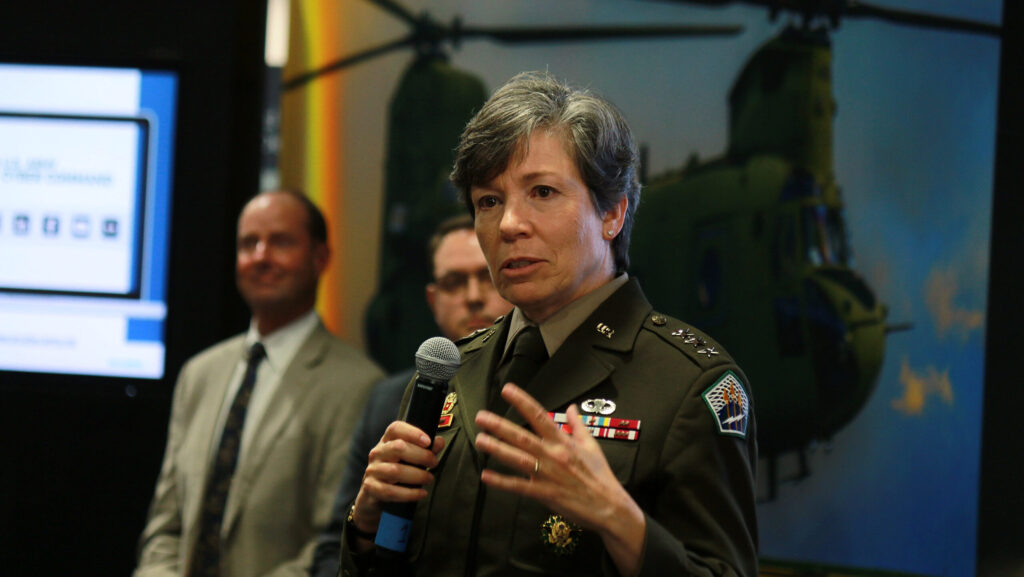
„The biggest opportunities that I see are from a modularity and platform independence standpoint. I think our approach is to use shared frameworks and APIs [application programming interfaces] in order to have cyber and EW [electronic warfare] effects be able to talk to each other,” said Lt. Gen. Maria Barrett, the commanding general of Army Cyber Command, during a fireside chat in Augusta.
Supporting Next Generation Command and Control (NGC2)
Army leaders have stated that interoperable capabilities will be vital in working with its sprawling Next Generation Command and Control (NGC2) initiative. NGC2 aims to combine intelligence, C2, and fires into a single system, providing commanders with more readily available information.
Tactical Flexibility and Training Benefits
„If you’re a commander on the battlefield, I think that just means, you know, bottom line, it’s tactical flexibility. It’s the ability to take an effect and put it against any platform,” Barrett said. She added that the ability to reuse effects and plug them onto platforms according to the target will reduce training requirements.
Decreasing Technical Debt
Buying interoperable capabilities will also help decrease the Pentagon’s mounting technical debt over time. Barrett emphasized that a modularity will allow the Army to future-proof its capabilities, avoiding the need for complete redesigns due to engineering tech debt.
Operability at the Tactical Edge
Barrett stressed that industry needs to ensure that such tools are engineered to be operable at the tactical edge, particularly in denied, degraded, intermittent, and limited (DDIL) environments. „You need to make sure that this can work at the edge and then come back. Don’t try to take an enterprise solution and then really try to do cheetah flips to make it work at the edge. It just, it just really isn’t a good approach,” Barrett said.
Designing for Contested Environments
Barrett advised industry to design for contested environments when building new capabilities and to plan for DDIL scenarios. „You train like you fight. So every experimentation, every CTC [combat training center] rotation, every warfighter, we need to be inserting real-world scenarios,” she added.