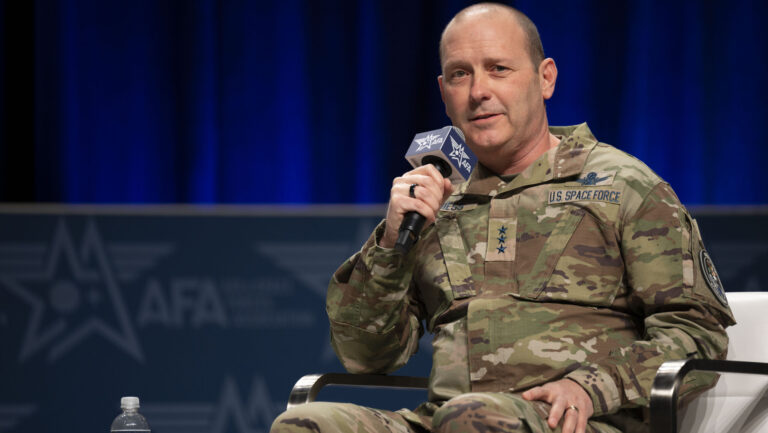
With a hearing marked by rather cordial questions from the six senators in attendance, Lt. Gen. Doug Schiess seems to have a clear path to becoming the third chief of the Space Force. The relaxed atmosphere within the Senate Armed Services Committee was interpreted by lawmakers not as a lack of interest, but as a testament to full confidence in the nominee’s capabilities.
A low-key hearing interpreted as a signal of political support
Senator Angus King emphasized that the low turnout at the hearing should be seen as a compliment to the general. On a day when Senate attention was captured by hearings for the position of attorney general, the lack of controversy in Schiess’s case was considered an asset. „The fact that we didn’t have a large turnout is an indication, I believe, of the committee’s confidence in you,” King noted, adding that in this rare case, a small audience is a positive sign.
Committee Chairman Roger Wicker reinforced this view, encouraging Gen. Schiess to accept these remarks as a validation of his career thus far.
The autonomy challenge: Space Force facing the risk of overlapping with intelligence services
Beyond the friendly tone, Senator Angus King touched on a sensitive point: the need for the Space Force not to duplicate programs already under the purview of the National Reconnaissance Office (NRO). Schiess provided assurances that he would maintain close relations with NRO leadership to avoid any waste of resources or redundant efforts.
The demarcation of authorities between the NRO and the Space Force has remained a gray zone since the space service’s creation in 2019. Recent congressional concerns target the NRO’s increasing involvement in Space Force intelligence, surveillance, and reconnaissance (ISR) acquisition programs, including satellites intended for tracking targets on the ground and in the air. Senator Jack Reed raised questions regarding the institutional identity of both entities, highlighting that the expansion of the NRO’s traditional role in Space Force acquisitions requires careful management.
Electromagnetic warfare and the need for total integration with other military branches
Another major theme addressed during the hearing was cooperation with the Air Force in the realm of electromagnetic warfare. Senator Reed emphasized the importance of synergistic collaboration, given that both services operate in overlapping spaces.
Gen. Schiess, drawing on his experience in joint operations at US Space Command, stated that there is significant potential for cooperation not only with the Air Force but also with the Navy and Marine Corps, which are developing their own electromagnetic capabilities. „I believe that we can be complementary of each other and I believe that we can work together,” Schiess declared, promising that, if confirmed, he would work closely with other service chiefs to ensure the effective integration of these cutting-edge technologies.