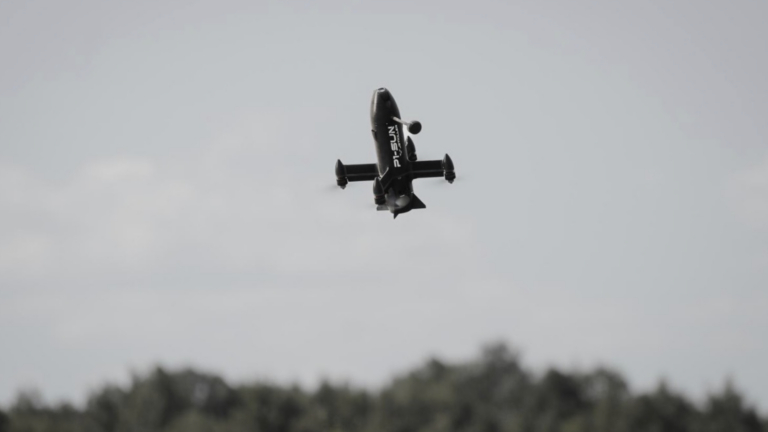
At the Farnborough International Airshow, the Ukrainian company Skyfall officially revealed a new strategic weapon for airspace defense: the P1-SUN Jetkiller interceptor drone. Specifically designed to counter Russian jet-powered versions of Shahed drones, this new technology promises to strike the enemy at its most vulnerable moments, offering a fast and efficient solution against constant aerial barrages.
Speed and precision: A project developed in just three months to neutralize Russian jet-powered drones
The P1-SUN Jetkiller is the latest member of the P1-SUN drone family, created in a record time of just 90 days as a direct response to the urgent requirements of the Armed Forces of Ukraine. According to company representatives, the drone has already been tested in real combat conditions, recording dozens of confirmed hits on the front line. The interceptor has been optimized to reach speeds of up to 370 km/h, a significant improvement over previous variants, allowing it to catch up with enemy drones when they reduce speed for maneuvers or during specific flight segments.
Industrial-scale mass production: A target of 50,000 units per month to defend Ukrainian skies
To cope with the massive volume of attacks, Skyfall plans to move to mass production of the Jetkiller model starting in August 2026. The objective is highly ambitious: manufacturing 50,000 units every month. This industrial capacity is considered vital, given that Russian forces are increasingly using Shahed drones as an alternative to long-range artillery to hit targets deep inside Ukrainian territory.
Tactical innovation on the front lines: Launching from helicopters and An-28 aircraft extends interceptor range
A key feature of the new Jetkiller drone is its deployment versatility. Skyfall representatives emphasized that the interceptor can be integrated onto various platforms, including helicopters or transport aircraft such as the Antonov An-28. Launching directly from the air offers a major tactical advantage: it saves battery power that would otherwise be consumed during takeoff and ascent, and it considerably extends the system’s operational range. This method has already shown remarkable results, contributing to the destruction of hundreds of enemy drones and shifting the balance of power in the war of aerial attrition.