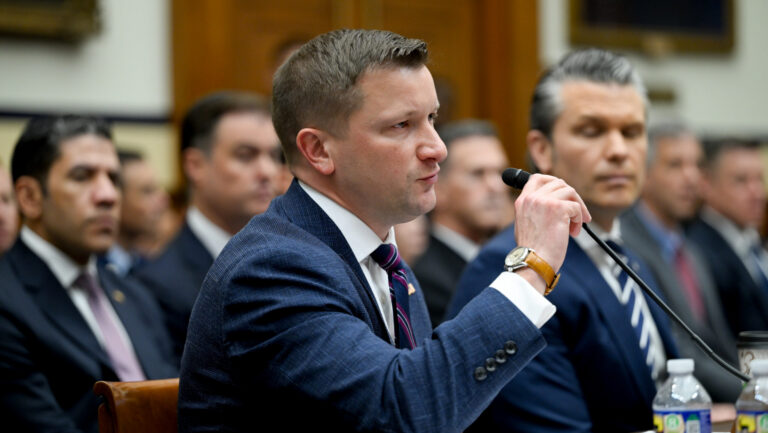
After a year-and-a-half vacancy in the Pentagon’s top financial role, the Senate voted today 50 to 47 to officially confirm Jules “Jay” Hurst as Comptroller. The vote, part of a broader en bloc package, also greenlit key nominees for the Space Force and the National Reconnaissance Office (NRO).
Hurst, who had been performing the duties of Comptroller since August 2025, officially returns to oversee defense budgets at a moment of peak pressure. His objectives are ambitious: passing the first clean audit by 2028, aligning budgets with the rapid evolution of modern warfare, and expanding the industrial base. However, the new Comptroller is already facing criticism regarding transparency, particularly concerning the true costs of military operations against Iran.
Hurst’s mission: A historic audit and the hidden costs of the Iran war
Hurst’s confirmation was not without tension. Senator Jack Reed pressed him on the difficulty of obtaining information about the actual cost of the Iran conflict. While Defense Secretary Pete Hegseth recently estimated that certain aspects of the war would cost $37.5 billion through the end of fiscal 2026, senators remain frustrated by the lack of clear details.
Beyond managing supplemental funds for Iran, Hurst must ensure that $152 billion in 2025 reconciliation spending is placed under contract by the end of September. Failing to do so risks an automatic 8.3 percent cut to the remaining balance, a major bureaucratic challenge in a highly fragmented political landscape.
A new “czar” for space acquisition: Erich Hernandez-Baquero takes the helm of Space Force
In the same voting bloc, lawmakers approved Erich Hernandez-Baquero, known as “HB,” as the next assistant secretary of the Air Force for space acquisition and integration. Hernandez-Baquero, a retired colonel and former Raytheon executive, becomes only the second permanent appointee to this post, created by Congress in 2020 to centralize space procurement.
His mission is monumental: he will manage an exploding investment budget set to reach $59 billion in 2027, up from $18.9 billion in 2026. Beyond the numbers, he must implement a major workforce realignment, adding new portfolio acquisition executive structures covering advanced capabilities, electromagnetic warfare, and cyber strike.
Roger Mason leads the NRO during a critical integration phase
The confirmation package also included Roger Mason to lead the National Reconnaissance Office (NRO). With extensive experience in the intelligence community, Mason replaces Chris Scolese, who led the spy satellite agency for nearly seven years.
Mason takes over an institution whose relationship with the Space Force is vital but historically marked by disputes over mission authority and acquisition oversight. During his hearings, Mason emphasized the importance of a strong partnership between the NRO and the Space Force, calling it a pillar of “good governance” in a field where space-based intelligence has become the centerpiece of American defense strategy.