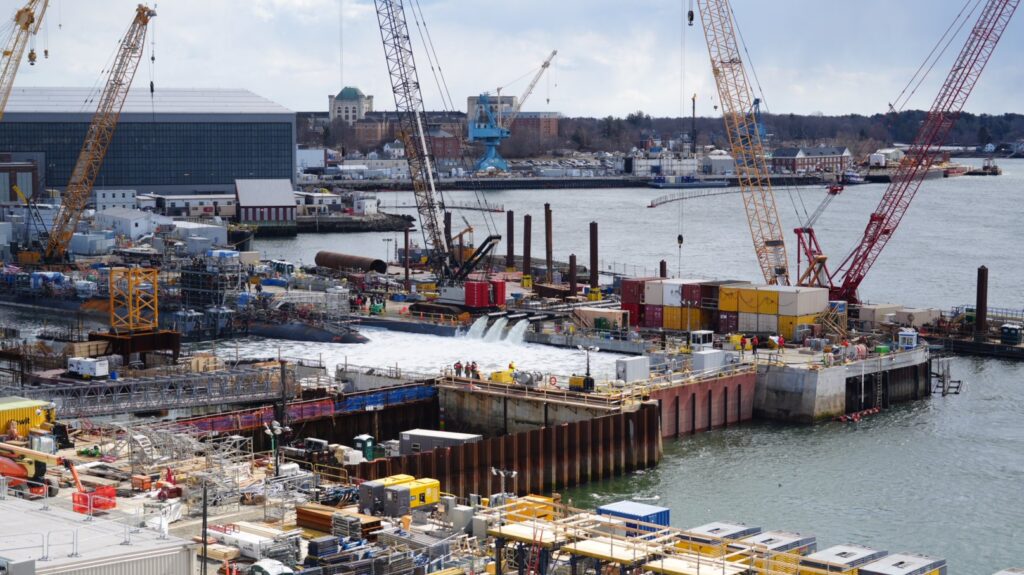
The US Navy’s youngest public shipyard is more than a century old — and the service is struggling to keep its nuclear-powered carriers and submarines ready for sea. Against that backdrop, President Donald Trump has put a bold idea on the table: build a fifth public shipyard to expand repair capacity for the fleet’s most critical assets.
The plan surfaced in a new National Security Presidential Memorandum, which outlines several initiatives aimed at improving readiness. At its core is a directive for Defense Secretary Pete Hegseth to deliver, within 120 days, a proposal to boost submarine and aircraft carrier readiness by leveraging both private industry and a brand-new public yard.
A New Yard With a Multi-Billion-Dollar Price Tag
The notion of adding a fifth public shipyard is not entirely new. For years, the Navy has wrestled with persistent maintenance delays across its depots. In April, Chief of Naval Operations Adm. Daryl Caudle acknowledged that the service was actively studying the idea of a new public yard, even as he voiced concerns about:
- where the Navy would find the workforce to staff it;
- how much such a project would ultimately cost.
Two analysts speaking with Breaking Defense agree the Navy needs more capacity, especially if it intends to grow under its latest shipbuilding plan. But they caution that building a new public yard would be extremely expensive — and might not fix what is fundamentally a workforce problem.
“If you go down this path, it’s expensive, and it would take a long time,” said Eric Labs, a senior analyst for naval forces and weapons at the Congressional Budget Office. “You’re talking about building new shipyards that would take at least a decade, maybe more. And cost estimates for something like that have been varied over the map. But for nuclear-powered — meaning a shipyard capable of doing maintenance on nuclear-powered ships — you’re probably talking about something in the $10 to $20 billion range in today’s dollars.”
Politics Is Easy, People Are Hard
Despite the intimidating price tag, outright political opposition is not what analysts expect to derail the idea. Bradley Martin, a senior policy researcher at RAND and retired Navy captain, argues that the bigger obstacle is practical, not partisan.
“It’s not really a political problem supporting ship maintenance and ship construction,” Martin said. “It’s more like a practical problem of who you’re going to get to come do it.”
In other words, Congress may be willing to sign the checks — but money alone cannot conjure a skilled industrial workforce in the numbers required.
Choosing a Site: History on the East Coast, Eyes on the Pacific
How much a new shipyard would cost depends heavily on where it is built. The Navy once operated several other public yards — Philadelphia, Charleston, Mare Island and Long Beach — all shuttered as naval facilities in the 1990s following the Base Realignment and Closure (BRAC) rounds. Today’s four public yards are located in Virginia, Maine, Washington and Hawaii.
What remains unclear is whether the administration wants to:
- create a completely new yard at a greenfield site;
- resurrect one of the former naval shipyards;
- or repurpose another legacy facility.
“One of the first steps you have to do would be to identify where you’re going to put the shipyard,” Labs said. “Because by identifying where you’re going to put the shipyard, then you’ve got to figure out how much it’s going to cost, and that is to some degree going to be site-dependent.”
While most legacy yards are on the East Coast, the memorandum suggests the administration is looking west.
A Pacific-Focused Yard for a Growing Attack Submarine Fleet
The presidential memo directs that the plan for a fifth yard must address:
- sufficient drydock capacity to service the planned growth of the fast-attack submarine fleet over the next two decades;
- locations proximate to the US Pacific Fleet, including within the continental United States, Alaska, Hawaii and US territories;
- site options that include up to three new drydocks, designed and built to accommodate every current and projected class of submarine;
- innovative financing mechanisms, such as public-private partnerships;
- realistic timelines and resourcing requirements.
Congress will still have to buy in. Labs notes that funding could be spread across years, but only if lawmakers and the White House agree that the effort is both urgent and essential. “You certainly have to get the Congress and the administration in agreement that this is something that needs to happen, and therefore it needs to be funded,” he said. “It’s not something that has to be funded all in one year.”
SIOP: Don’t Rob Existing Yards to Build a New One
The Navy is already in the midst of a sweeping effort to modernize its existing four public shipyards. The Shipyard Infrastructure Optimization Program (SIOP), launched in 2018, is a more-than-20-year plan to:
- upgrade dry docks;
- modernize and standardize critical equipment.
Navy officials told Breaking Defense in 2025 that once SIOP wraps up, they expect:
- roughly a 10 percent improvement in aircraft carrier maintenance;
- about a 15 percent improvement in submarine maintenance.
A typical submarine maintenance availability now lasts 25 to 36 months. SIOP-related improvements are expected to shave roughly three months off that timeline.
Any new public yard could be folded into SIOP’s broader framework or proceed as a stand-alone project. Either way, Labs warns that funding for a fifth yard must not come at SIOP’s expense.
“Any public shipyard is going to be additive on top of that, and you wouldn’t want to do it in such a way that the money competes with the SIOP efforts because the SIOP efforts are really essential,” he said.
Martin agrees SIOP could house work tied to a new yard, but he returns to the same core concern: labor.
“It’s ongoing and potentially that could be expanded, but the really, really big issue with all of this is labor and getting people who can actually do all this work,” he said. “That’s not something that’s going to be done in a year or two. That’s a generation-long thing.”
A Workforce Problem That Money Hasn’t Fixed
The Navy has struggled to retain shipyard workers despite aggressive hiring. In fiscal 2023 alone, officials reported millions of applications and nearly 10,000 new hires. Yet a large share of those new employees leave quickly, driven in part by compensation and retention issues.
“Those folks are coming, and then we’re attriting out way too quick,” Brett Seidle, then the Navy’s acting acquisition executive, told lawmakers in March 2025. “We probably are seeing 50 to 60 percent attrition in our first-year employees.”
That attrition rate calls into question how quickly — or even whether — a new shipyard could be fully staffed and productive.
A ‘Hard Push’ and the Cautionary Tale of USS Boise
The administration’s interest in an additional shipyard spilled into public view in June, when Office of Management and Budget Director Russ Vought declared that the White House was “pushing hard for an additional public shipyard” as part of its broader fleet expansion ambitions.
“If we’re going to spend a one-and-a-half trillion dollars, or have the types of direct foreign investment that’s coming in, we want to make sure that we have the ability to have enough public shipyards to do maintenance,” Vought said at the Washington Times’ IndoPac 2026 event. “You’re going to have contracts with companies that are doing maintenance [in private shipyards], and that’s all fine, and will continue, but … to do it at scale is something that is absolutely vital.”
Vought pointed specifically to the fate of the Los Angeles-class attack submarine USS Boise, which had not operated at sea for more than a decade and endured a cascade of maintenance delays before the April decision to inactivate the boat.
“We all agree that at that point it needed to occur, but that had come after 10, 15 years of bad management, and we need to fix that,” he said.
Martin acknowledges that Boise’s saga likely influenced the administration’s push for a new yard, but he believes the root cause lies less in the number of facilities and more in the lack of a stable, skilled workforce.
“The impulse to expand public shipyard capacity is a good one,” Martin said. “The idea that [that] is best done by opening another shipyard is a little bit more problematic.”
As the White House leans into its “hard push” and the Pentagon begins drafting options, the central question remains: will Shipyard Number Five become the linchpin of a stronger nuclear fleet, or just another costly monument to problems that start and end with people, not concrete and steel?