Today’s commanders no longer have the luxury of time. Critical mission information must be available not just quickly, but instantly – and it must be trusted. In a battlespace where every second matters, the contest is no longer about accessing data, but about validating it and turning it into action faster than any adversary can react.
Lockheed Martin is positioning its space architecture precisely at this fault line: where secure, multi-orbit information flows can tip the balance in favor of the side that decides first – and correctly.
From Raw Data to Edge: Whoever Controls Time Controls the Fight
Once intelligence reports indicate a threat, every decision that follows becomes vital. Every moment spent questioning sources, filtering noise or interpreting data grants the opponent more room to maneuver.
The central challenge is no longer the absence of mission data; it is the question at the heart of modern command: can that data be trusted and used immediately to drive a decisive response?
In tomorrow’s battlespace, victory will go to the force that can convert secure information into operational advantage at greater speed than its rival. That “decision advantage” is not delivered by a single platform, but engineered across an integrated architecture stretching from orbit to ground.
Trusted Awareness in GEO: The Backbone of Early Warning
Every sound decision begins with an accurate picture of the operational environment. In missile defense, that means persistent, trustworthy awareness of threats.
For years, the Space-Based Infrared System (SBIRS) has served as the backbone of US space-based missile warning and tracking. Its persistent global coverage showcases Lockheed Martin’s deep technical experience in missile warning and tracking solutions.
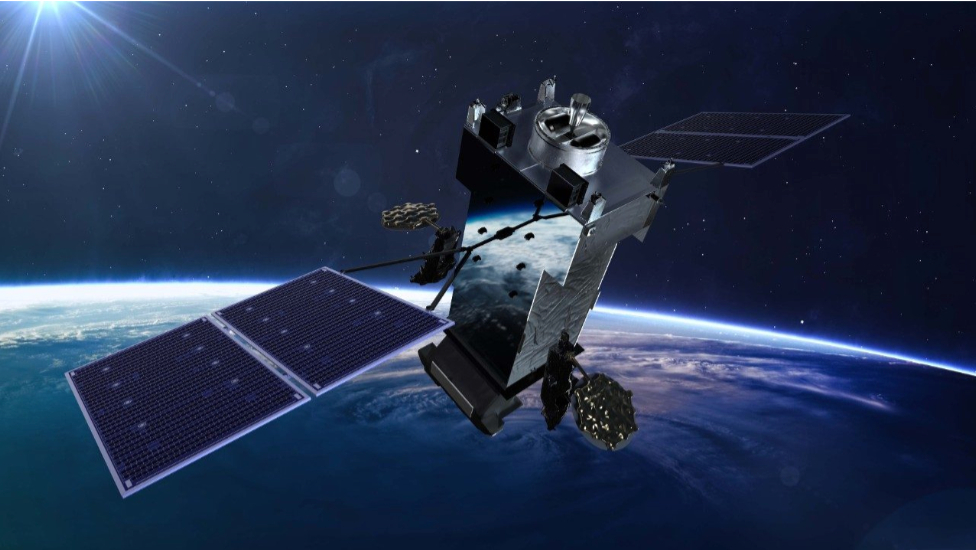
The company is now taking that expertise a step further with the Next-Generation OPIR GEO (NGG) program. Purpose-built for emerging threats – including hypersonic weapons – NGG is designed to:
- enhance sensing performance for earlier detection;
- increase the resiliency of OPIR satellites;
- deliver advanced survivability against evolving threats via the LM2100 Combat BusTM.
Together, these systems provide the trusted awareness needed in geosynchronous orbit, giving US decision-makers the ability to see beyond today’s threat set and anticipate what comes next.
Information Only Matters If It Moves
No matter how accurate, information cannot create advantage if it remains locked within a single sensor or a single orbit. Modern architectures must move data:
- rapidly;
- securely;
- with low latency;
- seamlessly between sensors, operators and weapon systems.
Lockheed Martin’s Transport Layer satellites, built on the LM50 bus, are tailored to that mission. They:
- deliver secure, resilient, low-latency communications;
- rapidly distribute data from the tracking layer across the force;
- move trusted information between sensors, operators and mission systems at operational speed.
Multi-Orbit Resilience: GEO, LEO and MEO in One Architecture
Resilient architectures are not built in a single orbital shell. Maintaining custody of increasingly sophisticated missile and hypersonic threats requires a layered design across GEO, LEO and MEO.
The US Space Force is fielding a Resilient Missile Warning/Missile Tracking layer in medium Earth orbit (MEO), introduced in stages through successive Epochs. The emerging construct is designed to:
- complement missile warning capabilities in GEO;
- reinforce missile tracking capabilities in LEO;
- increase persistence and redundancy through coverage across orbital regimes.
Lockheed Martin is competing for the Epoch 2 contract, underscoring its commitment to supporting the evolution of the US missile warning, tracking and defense architecture. Rather than optimizing for a single orbit, the company is developing capabilities that enable proliferated, multi-layer architectures.
Strengthening Every Link from Detection to Effect
In an environment where decision timelines are relentlessly compressing, every link between detection and action must be engineered to strengthen the next.
The architecture Lockheed Martin is pursuing spans:
- persistent awareness in GEO through systems such as SBIRS and NGG;
- proliferated sensing and data transport in LEO for rapid collection and dissemination;
- growing resilience in MEO through future Resilient MW/MT capabilities.
Taken together, these layers:
- detect threats earlier;
- deliver trusted information to commanders;
- accelerate the decision cycle;
- support coordinated action across the long-range kill chain.
Architectures for JADO: A Full-Spectrum, System-of-Systems Approach
In Joint All-Domain Operations (JADO), where space, air, maritime, land and cyber domains are tightly interconnected, the role of a full-spectrum mission systems integrator becomes central.
Lockheed Martin’s portfolio reflects a systems-level approach to:
- integrating diverse sensors;
- operating space platforms in multiple orbits;
- maintaining resilient communications links;
- interfacing with command-and-control structures and effectors across domains.
As decision windows continue to close, the objective is clear:
- build architectures that move information without friction;
- harden those architectures against attack and disruption;
- enable faster, more coordinated action.
Viewed individually, each capability strengthens the mission. Engineered together, they create something larger: true decision advantage. That is the architecture Lockheed Martin says it is building today.