A1, A2 and A3 pave the way for a potential loyal wingman system
Saab is developing three unmanned aircraft — the A1, A2 and A3 — that could pave the way for a new loyal wingman system designed to operate alongside Gripen fighter jets.
The project was presented during events marking the centennial of the Swedish Air Force. The three aircraft are being developed as autonomous collaborative platforms, Saab’s term for systems capable of carrying out coordinated missions alongside manned aircraft.
Swedish Defense Minister Pål Jonson views the development of such a system as a natural evolution of the Gripen family. In his assessment, an unmanned aircraft could conduct deep operations while supporting a manned mother platform.
The first demonstrator will be supersonic
The A1 will be a supersonic demonstrator powered by a GE F414 engine supported by artificial-intelligence-based control systems. The same engine powers the Gripen E/F.
Saab expects the A1 to make its first flight within the next 15 months, while both initial models — the A1 and A2 — are expected to fly within four years.
The A2 will introduce an important combat capability: an internal weapons bay. Carrying weapons inside the fuselage could reduce the aircraft’s radar signature and allow it to operate in heavily contested airspace.
A3 could become the production version
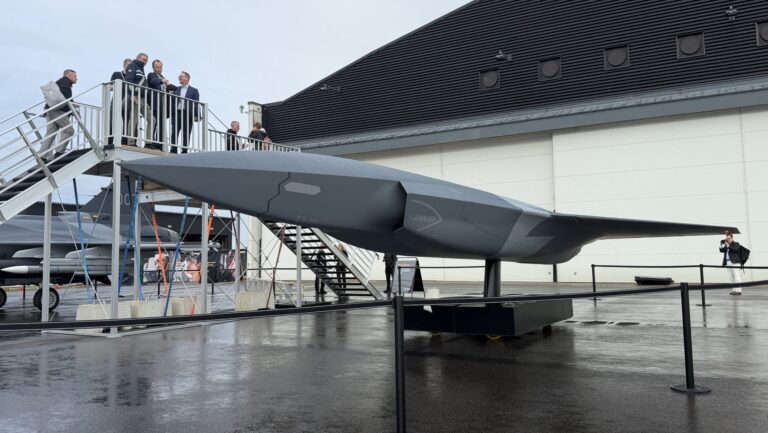
The A3 is viewed by Saab as the potential sales product of the family. A full-scale model was displayed outside one of the company’s hangars.
If the Swedish government approves the required funding, the aircraft could enter service within approximately ten years. A decision on financing the A3’s development has not yet been made.
Saab estimates that the lifecycle cost of one A3 could amount to roughly one-third of that of a Gripen E. Its initial acquisition cost is expected to be approximately half that of a Gripen E.
Sweden considers mixed squadrons
Brig. Gen. Niclas Magnusson, Sweden’s deputy air chief, expects future formations to include both manned aircraft and autonomous platforms.
In his view, future squadrons will not be exclusively manned or unmanned, but will combine both categories. Such a structure would allow missions to be distributed between crewed aircraft and autonomous systems according to the level of risk and the operational objectives.
Saab’s concept is broadly comparable to the U.S. Collaborative Combat Aircraft program. Sweden’s defense industry, however, uses the term Autonomous Collaborative Platform for this category of systems.
A program to replace or supplement the Gripen E
In 2024, the Swedish Defence Materiel Administration awarded contracts to Saab in Linköping and GKN Aerospace in Trollhättan.
The “Combat Aircraft Path Selection” program covers studies, technology development and the preparation of demonstrators. Its objective is to support a decision on the future of Sweden’s fighter capability after 2040, when the Gripen E will have to be replaced or supplemented by a new platform.
The Swedish parliament, known as the Riksdag, is expected to decide the direction of the program between 2028 and 2030. Until then, authorities will assess proposals from the Swedish Armed Forces and the defense procurement administration.
A new budget proposal is expected in March, while a government inquiry into industrial and defense policy and recommendations from a parliamentary reference group are also expected to contribute to the final decision. The group’s input is due in September 2027.
NATO membership accelerates Saab orders
Sweden’s accession to NATO has strengthened Saab’s international position. The company currently has an order backlog worth approximately 318 billion Swedish kronor, equivalent to about $33.6 billion.
The portfolio includes three A26 submarines for Poland, 16 Gripen E aircraft for Ukraine, GlobalEye aircraft for Canada and NATO, and equipment for Germany’s new frigates. The latter includes combat systems, composite structures and sensors.
Saab’s leadership believes Sweden’s NATO membership directly contributed to several of these contracts. The alliance would have had greater confidence in the GlobalEye platform once Sweden became a member, while Poland’s decision to select Swedish submarines may also have been influenced by the country’s new strategic status.
New Middle Eastern customer orders two GlobalEye aircraft
Last month, Saab received an order for two GlobalEye aircraft from an undisclosed Middle Eastern country.
The company said only that the customer is a new one. The contract is valued at approximately 10.1 billion Swedish kronor, or about $1 billion, with deliveries scheduled for 2030.
Gripen has operated alongside NATO for more than two decades
The centennial of the Swedish Air Force highlighted the changes brought about by Sweden’s NATO membership. Just a few years ago, it would have been difficult to imagine F-35s operating alongside Gripens on a Swedish military airfield.
Saab nevertheless emphasizes that the Gripen met NATO standards long before Sweden joined the alliance.
The Gripen C, introduced in 2002, was already interoperable with NATO systems and compliant with alliance requirements. The Swedish Air Force had therefore operated alongside NATO partners for many years before the country formally joined the alliance.