Proposal deadline extended to Oct. 30, 2026
The U.S. Navy has postponed the planned award date for its new jet trainer and extended the deadline for companies to submit proposals for the competition.
According to a new request for proposals, the Navy now plans to award the contract for the Undergraduate Jet Training System, or UJTS, on June 30, 2027.
The service had previously announced that it intended to select a winner in March 2027.
Second extension to the proposal deadline
The Navy has also revised the deadline for submitting proposals. Competitors will now have until Oct. 30, 2026, to submit their bids, instead of the previous deadline of Sept. 9, 2026.
This marks the second extension to the schedule. The Navy originally set July 2026 as the deadline for proposals.
Aviation Week was the first publication to report on the updated request for proposals.
New aircraft will replace the T-45 Goshawk
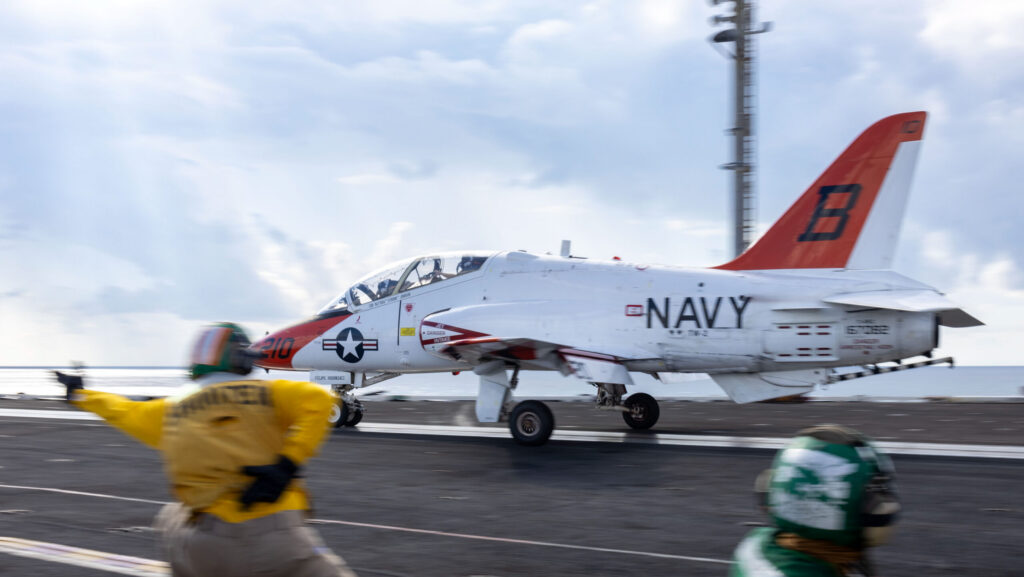
The new jet trainer is intended to replace the Navy’s fleet of T-45 Goshawk aircraft, which the service first began operating in the early 1990s.
The T-45 is used by the Navy and Marine Corps to train aviators for carrier-based jet operations and tactical strike missions.
The UJTS is expected to prepare the next generation of naval aviators for complex air operations as the Navy modernizes both its combat aircraft fleet and its training infrastructure.
Carrier-landing requirements have been removed
In a request for proposals released in March, the Navy stated that the new trainer would no longer be required to land on aircraft carriers, unlike the T-45 Goshawk.
The Navy also said the aircraft would not be required to conduct the full range of Field Carrier Landing Practice, or FCLP, operations. FCLP involves practicing carrier landings on an airfield runway.
Instead, the aircraft must support the “wave-off” portion of FCLP. A wave-off occurs when a pilot abandons an attempted landing and returns to the air for another approach.
Navy seeks advanced simulation capabilities
Rather than requiring full carrier-landing capability, the Navy is asking competitors to describe “unique aircraft simulation capabilities” that can prepare aviators to land on aircraft carriers.
The approach could reduce the cost and complexity of the new aircraft by shifting more of the training burden to simulators and digital training systems.
At the same time, the Navy will need to ensure that pilots trained on the new system acquire the skills required for real-world operations, including the demanding approach and landing phases of carrier aviation.