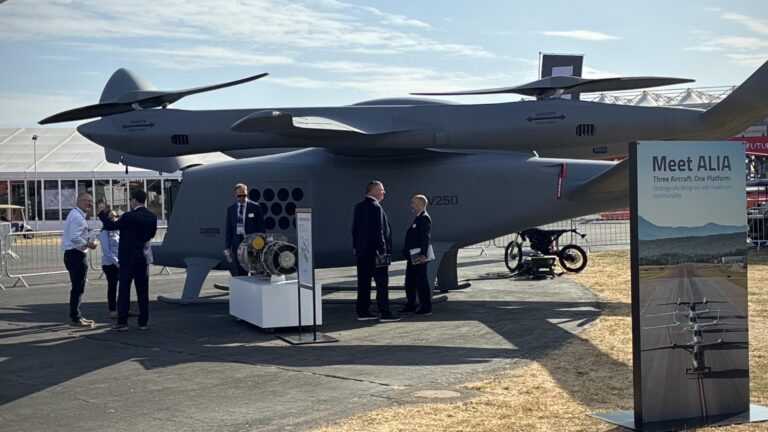
At the prestigious Farnborough Airshow, the defense industry witnessed a debut that promises to rewrite the rules of aerial logistics and reconnaissance. American firm BETA Technologies unveiled the MV250, a militarized and autonomous variant of its electric aircraft, now transformed into a hybrid powerhouse capable of meeting the harshest demands of the modern battlefield.
Power Hybridization: Beyond the Limits of All-Electric Propulsion
The great innovation of the MV250 lies in its propulsion system. While the civilian version relied solely on batteries, the military version integrates a hybrid-electric powertrain developed in partnership with GE Aerospace. This modification is far from symbolic: the GE CT7 turboshaft engine (a close relative of the famous T700 that powers Apache helicopters) provides the aircraft with roughly eight times the range of the all-electric variant.
With a range of approximately 1,300 nautical miles and a payload capacity of nearly 2,000 pounds, the MV250 is designed for diverse missions, from rapid logistics to precision strikes and reconnaissance. „We focused on simplicity and efficiency. By keeping it light and aerodynamically clean, we achieve speed and long range—exactly what the customer cares about,” company officials emphasized.
Sikorsky’s MATRIX: The Autonomous Brain for a New Generation of Aerial Predators
The MV250 is not only high-performing but also highly intelligent. For autonomy, BETA tapped the expertise of Sikorsky, a Lockheed Martin subsidiary. The integration of the MATRIX technology suite—already tested on pilotless Black Hawk helicopters—transforms the MV250 into a versatile tool ready to execute complex missions without risking pilots’ lives.
This synergy between an innovative startup and aerospace giants aims to deliver mature technology that can be operated by soldiers directly on the front lines, with significantly lower maintenance and operating costs compared to traditional platforms.
Low Cost, High Impact: The 2028 Production Roadmap
BETA Technologies’ market strategy is as aggressive as its aircraft design. With a target price tag below the $10 million threshold, the MV250 positions itself as an affordable and efficient alternative to conventional flight platforms.
Company officials are targeting major contracts with the U.S. Army, Air Force, and Marines, as well as international buyers. The first military exercises with the MV250 prototype are scheduled for next year, while mass production is estimated to begin in 2028. In an increasingly competitive market, where names like Anduril and Archer Aviation are proposing similar solutions, the MV250 appears ready to set the new standard in light military aviation.