Modern uncrewed aerial systems have transformed airspace defense into a rapid, asymmetric and difficult-to-predict contest. Low-cost drones, sometimes priced at less than $1,000, can inflict significant damage on critical infrastructure and high-value assets, placing pressure on traditional radar-centric defenses and point-defense systems.
Military infrastructure, bases, sensor networks and personnel are now exposed to threats that can emerge quickly, operate in large numbers and approach from multiple directions. Effective protection can no longer depend on a single sensor or one type of weapon.
A Distributed Network for Detection, Decision and Defeat
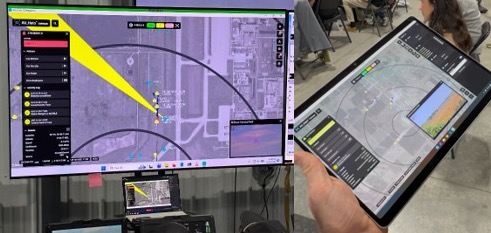
Halo_Shield was designed for this operational environment. It is a modular, distributed counter-UAS architecture that combines data from passive and active sensors and turns it into a coherent command-and-control picture through the AV_Halo software platform.
The system is deployed through “Tiles” — integrated components that combine sensors, tactical effectors and command functions into resilient, cross-domain kill chains. This approach enables earlier threat detection and reduces the risks associated with isolated, single-mode defenses.
The architecture can integrate systems such as the LOCUST high-energy laser, along with acoustic, optical, radio-frequency and radar sensors.
From Promising Prototype to Operationally Tested System
During the T-REX 25-2, TWIX 2026 and T-REX 2026 exercises, Halo_Shield progressed from a promising prototype to a system tested in demanding and operationally realistic conditions. The evaluations examined the full kill chain, from threat detection and identification to effect selection and engagement confirmation.
T-REX 25-2: First Field Validation
Held at Camp Atterbury, Indiana, T-REX 25-2 assessed the readiness of the Halo_Shield architecture for real-world base defense against uncrewed aerial threats.
The evaluation focused on four priorities: the ability to combine data from multiple passive sensors into a common operating picture, operation in contested environments, contribution to layered base defense, and realistic production and sustainment requirements.
Halo_Shield operated as a software-driven, multi-sensor tracking and data-fusion platform. It integrated information from Walaris AirScout, which provides acoustic and optical capabilities; Squarehead Discovair, an acoustic detection system; AV Titan SV, a passive radio-frequency sensor; and cooperative data feeds.
For the exercise, the architecture was deployed as a vehicle-mounted Terrestrial Tile. The scenarios included simulated hostile flights, more complex maneuvers and limited swarm activity involving Group 1–3 UAS.
The results showed that the system could rapidly combine information from different sources, detect small drones passively and provide visual confirmation without requiring extensive manual intervention. Halo_Shield became operational in approximately 15 minutes, while more complex configurations required an additional 15–20 minutes for software setup and configuration.
During the trials, the system achieved nearly 100 percent availability, with no software crashes or hardware failures reported.
Interoperability Under Real-World Conditions
Another important result of T-REX 25-2 was the rapid integration of the exercise’s OMNI messaging format. This enabled Halo_Shield to participate in the Passive Multi-Spectral Air Surveillance Kill Chains architecture, as well as the Ninja Fusion and TRAX environments.
The evaluation demonstrated that Halo_Shield could function as a robust and interoperable fusion and command-and-control platform for distributed base defense.
TWIX 2026: Agility and System-Level Cooperation
Held in Sumter, South Carolina, TWIX 2026 brought together elements of the U.S. Air Force, research and analysis organizations, the National Guard, the Department of Homeland Security and industry representatives.
For Halo_Shield, the event served as an interoperability trial. The system was pre-deployed, deployment requirements were established, real-world sensor data was collected, and the ability to coordinate layered defense using multiple sensors and effectors was evaluated.
Halo_Shield combined acoustic, radar and radio-frequency sensors equipped with built-in health-monitoring functions. It also provided centralized control of offensive and defensive tools, while delivering clear threat and system-status information through the intelligence, surveillance and reconnaissance capabilities of AV’s Puma LE.
The system did not operate in isolation. It was integrated into a broader command-and-control picture, demonstrating that it could be inserted into a complex operational environment and communicate effectively with systems developed by other partners.
Rapid Reconfiguration for Expeditionary Operations
Because integration took place before the event, teams were able to deploy, network, configure and operate the system on the first day. Remote nodes were repositioned and reconfigured with minimal downtime — an essential capability for mobile base defense and expeditionary operations.
TWIX 2026 also tested the resilience of both personnel and systems. Range outages, weather conditions and changing coordination requirements demanded rapid adaptation and decision-making under pressure.
The exercise identified several areas for further improvement, including simpler plug-and-play deployment, reduced configuration variability, improved tuning and data fusion, and clearer displays and operator workflows.
T-REX 2026: Full Kill-Chain Validation
Held at Grand Forks Air Force Base, T-REX 2026 was the most demanding Halo_Shield evaluation to date.
The architecture integrated AV_Halo, Argus Perimeter Security, AV Titan RF C-UAS and the LOCUST high-energy laser, together with Squarehead acoustic sensors, Axis electro-optical and infrared cameras, Walaris AirScout and SRC Gryphon active radars.
Over several days, teams combined radio-frequency effects and high-energy laser engagements against Group 1 and Group 2 UAS. The trials measured full kill-chain performance under real-world networking, safety and operational constraints.
Detection in Less Than a Minute
During the trials, the time between drone launch and detection was less than one minute. Identification and cueing for engagement generally followed within only a few seconds.
Halo_Shield rapidly defeated easier-to-engage UAS, achieved repeated kills against Group 2 platforms and neutralized a five-ship swarm in a short period of time. In one scenario, the system defeated a hovering UAS before its formal release.
The trials demonstrated the operation of the Terrestrial and Sentinel Tile configurations, while Celestial and Aerial Tiles were also tested live.
AV_Halo CORTEX and Puma ISR supported left-of-launch detection by identifying potential launch sites and pilot teams. They also monitored runway sectors for signs of pre-launch activity.
First High-Energy Laser Engagement at Grand Forks
One of the exercise’s most significant milestones was the first high-energy laser firing conducted at Grand Forks Air Force Base.
Halo_Shield served as the command-and-control system for LOCUST engagements. It managed cueing from the fused track, weapon-to-target pairing, engagement scheduling and commander confirmation, all under strict safety oversight.
Historically, laser firings had required external support. During T-REX 2026, AV_Halo COMMAND assumed that role and demonstrated the ability to coordinate the laser engagement process directly.
A Modular Solution for Airspace Defense
Technical evaluations and operator feedback confirmed that Halo_Shield met its objectives. The platform demonstrated rapid deployment, high availability, interoperability and the integration of multiple sensor and effector types.
Across the three exercises, the architecture demonstrated several key strengths:
- rapid deployment;
- near-continuous operational availability;
- fusion of data from multiple sensors;
- compatibility with different systems and standards;
- integration of radio-frequency and laser effects;
- modular and scalable architecture;
- distributed and resilient detection-to-defeat chains.
By combining modular Tiles, passive sensors and advanced command-and-control software, Halo_Shield offers a different approach to counter-UAS defense — one that is more distributed, more flexible and less dependent on a single defensive point.