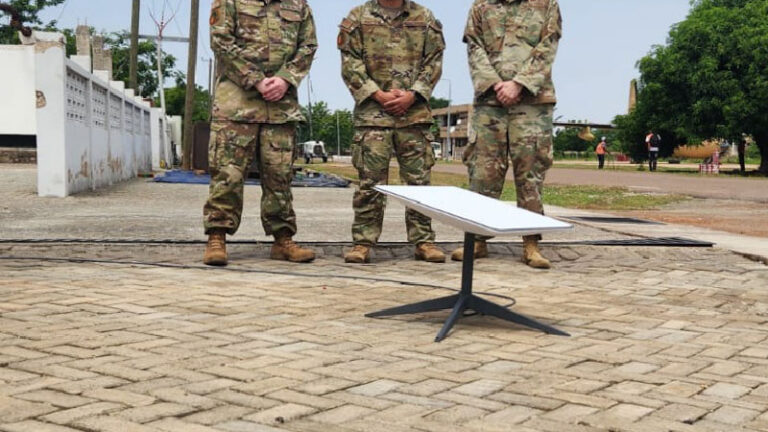
In temperatures exceeding 100 degrees Fahrenheit in California’s Mojave Desert, some Starlink ground terminals used by the U.S. Army began overheating. As the equipment’s performance declined, soldiers experienced difficulties transmitting and receiving the volume of data required for their missions.
With no contractor support available in the field, the soldiers had to troubleshoot the problem themselves. Their solution was remarkably simple: they soaked T-shirts in water and draped them over the terminals’ antennas to lower their temperature.
An Unexpected Problem During a Major Army Exercise
The overheating incidents occurred in July at Fort Irwin, during Project Convergence Capstone 6, one of the Army’s most important technology experimentation events.
The 4th Infantry Division was testing the limits of the service’s Next Generation Command and Control architecture in an environment designed to replicate the harsh conditions of modern combat more realistically.
Maj. Gen. Patrick Ellis, commander of the division, said some commercial technologies are not designed to operate reliably under extreme conditions. At the same time, soldiers demonstrated that certain shortcomings could be addressed through simple and rapidly applied procedures.
“There were a couple of cases where equipment overheated. When we use commercial technology, the systems are not always fully hardened for military environments. But we also found that there are very basic ways to deal with the heat. Some soldiers discovered that soaking a T-shirt in ice water and placing it over certain antennas could lower the temperature enough to keep them functioning,” Ellis explained.
Commercial Technology Offers Speed — but Not Always Durability
The incident became an important test for the Army’s evolving acquisition strategy, which prioritizes commercially available equipment.
Unlike systems developed specifically for military use, commercial products can generally be fielded more quickly and at a lower cost. The Next Generation Command and Control architecture includes Starlink terminals, as well as equipment using 5G and Wi-Fi connectivity.
The trade-off is that commercial products are not always designed to withstand extreme heat, dust, moisture, shock or other conditions associated with military operations.
Ruggedized and bespoke systems generally offer greater durability and capabilities tailored to military requirements. However, they are more expensive and typically require longer development, testing and production timelines.
The Field Lesson: Procedures Can Offset Technical Limitations
The primary prototyping phase for Next Generation Command and Control concluded with Project Convergence. The results will help define the baseline capabilities for the future architecture.
Army officials must now determine how extensively commercial products should be combined with ruggedized or purpose-built military systems.
Brig. Gen. Shane Taylor, who oversees programs related to command-and-control information networks, said officials already understood some of the limitations of commercial technology before the exercise. Even so, one of the most important lessons was the ability of soldiers to use tactics, techniques and procedures to address unforeseen problems.
In the case of the Starlink terminals, a water-soaked T-shirt was enough to keep the equipment operating.
Taylor emphasized that the Army should not automatically replace or completely redesign a system every time a limitation appears. Before investing several times more in hardened equipment, the service should determine whether a problem can be solved through simple procedures and straightforward training.
The Army Does Not Need to Reengineer Every Commercial System
Joseph Welch, the Army executive responsible for the command-and-control and counter-command-and-control acquisition portfolio, supported the same approach.
He argued that when a procedure can be easily applied, taught and understood — and does not reduce mission effectiveness — it may be preferable to over-ruggedizing equipment or requiring vendors to redesign products for extreme military conditions.
The approach represents a shift from the traditional model, in which commercial equipment was often extensively redesigned to meet every military requirement. The new strategy seeks to preserve the benefits of commercial technology while accepting certain limitations that can be managed through training and operating procedures.
Cooling Technology Becomes the Next Focus
The problems encountered in the desert have prompted the Army to examine additional technical solutions. One possibility is installing cooling systems on vehicles to help communications equipment and satellite terminals operate in high temperatures.
At the same time, continued innovation in the commercial market could deliver more resilient products in the coming years. Manufacturers are constantly developing new solutions for satellite communications, operational resilience and performance in difficult environments. The Army could benefit from these advances without bearing the full cost of developing dedicated military systems.
Lower Costs and Faster Fielding
Preliminary assessments indicate that the approach could substantially reduce expenses. Compared with legacy command-and-control equipment used at the division level, the new architecture could cost approximately 50 percent less. Depending on the mix of systems selected, savings could be even greater.
Cost reduction is not the only advantage. Commercial technology also allows the Army to field new capabilities more rapidly, at a time when military systems must keep pace with the fast-moving innovation cycle of the private sector.
The experience in the Mojave Desert also demonstrated that “commercial” does not automatically mean “ready for every combat environment.” The Army’s challenge will be to find the right balance between cost, speed of deployment, technical durability and operational effectiveness.