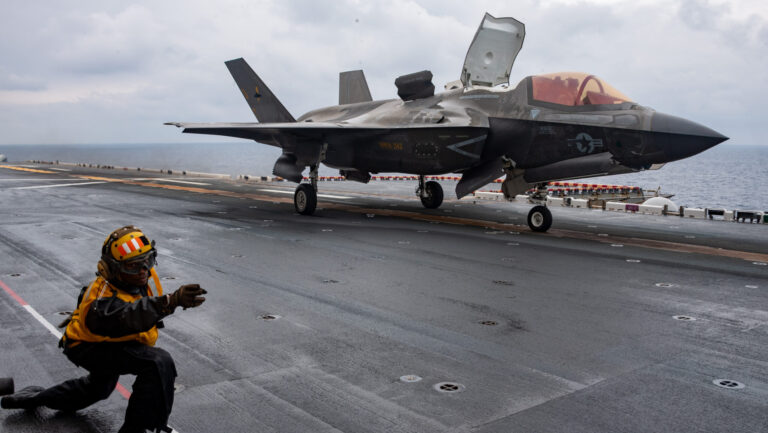
The cost of all three F-35 Joint Strike Fighter variants is increasing, according to the Pentagon. The average flyaway cost — a measure covering an aircraft equipped and ready for delivery — is set to rise significantly in production lots 18 and 19.
The F-35 Joint Program Office confirmed that the average cost of the conventional takeoff and landing F-35A will reach approximately $92 million. Aircraft from lots 18 and 19 are scheduled to be delivered over the next two years.
Compared with the $82.5 million price associated with the most recent group of production contracts covering 2023 through 2026, the increase amounts to approximately 11.5%.
The other two variants are also becoming more expensive:
- The short-takeoff-and-vertical-landing F-35B will cost approximately $121.4 million;
- The carrier-capable F-35C will reach approximately $110.8 million.
For the F-35B, the increase is approximately 11.4%, compared with its previous price of $109 million. The F-35C records the smallest percentage increase, rising by approximately 8.5% from its earlier cost of $102.1 million.
Inflation and Supply-Chain Problems
The F-35 program has been affected by inflation, higher raw-material prices and supply-chain disruptions. The Pentagon previously said those factors contributed to higher costs for lot 18.
The price increases also triggered a dispute with Switzerland. The disagreement ultimately contributed to Bern reducing the number of F-35s it planned to purchase.
Lockheed Martin previously said the Pentagon report reflects the F-35 program’s transition into full-rate production, the resumption of high-volume deliveries and the continued expansion of the international customer base.
The company also said that the central challenge is no longer proving the viability of the basic aircraft. Instead, the focus has shifted toward fleet modernization, improving operational availability and controlling long-term sustainment and integration costs.
What the Flyaway Cost Includes
The flyaway cost includes certain government-furnished equipment that falls outside the direct scope of Lockheed Martin’s contract.
That equipment includes the F135 engine, produced by Pratt & Whitney, a subsidiary of RTX. The upgraded radar is supplied by Northrop Grumman.
Delays involving the radar have forced the Pentagon to accept some new aircraft without the nose-mounted sensor. It remains unclear how much those components or their associated delays have contributed to the overall price increase.
Rising Program-Wide Costs
Projected F-35 acquisition costs have increased by more than $50 billion over the life of the program. The increase is attributed to several factors, including:
- additional modernization work;
- changes to the acquisition profile;
- increased demand for spare parts;
- efforts to improve aircraft availability rates.
At the same time, the F-35’s total life-cycle cost — including acquisition, operation and sustainment — has fallen below $2 trillion. The projected cost had exceeded that threshold in 2024.
Expensive Upgrades and Delays
One modernization effort is intended to improve the aircraft’s engine. A separate program seeks to provide a new power and thermal-management system designed to address the fighter’s cooling challenges.
Another modernization effort, known as Block 4, is expected to add a range of new capabilities. The program is nevertheless over budget and several years behind schedule.
Block 4’s computing backbone, known as Technology Refresh 3, has not yet been certified for combat use. As a result, aircraft delivered over the past two years have been limited primarily to training missions.
Twenty Customers Worldwide
A total of 20 customers, including the United States, are under contract to acquire F-35 aircraft.
International customers may have different requirements, and variations in configuration and integration can affect final costs. Most foreign customers are purchasing the F-35A, while some are acquiring the F-35B. The United States is currently the only operator of the F-35C.
The Pentagon plans to procure 148 aircraft in each of lots 18 and 19, for a combined total of 296 jets.
Lockheed Martin said in September 2025, when the contract was finalized, that the increase in the price per aircraft remained below the rate of inflation. The F-35 Joint Program Office has likewise said that the cost of the aircraft’s airframe remains “consistent” with previous years when adjusted for inflation.
A Program Balancing Mass Production and Continuous Modernization
The rising prices reflect the economic and industrial pressures facing the F-35 program. Although the aircraft is entering full-rate production and has developed a broad international customer base, the program must simultaneously absorb the cost of modernization, readiness problems and technology delays.
For the Pentagon, the challenge is not simply buying large numbers of aircraft. It is also maintaining them in operational condition and integrating new systems on schedule so that the fleet can deliver the capabilities promised by the program.