Lockheed Martin is intensifying its internal investment in the development of the Vectis stealth drone. The company has announced plans to build four additional prototypes alongside the first aircraft, which is already under construction.
Expanded testing and production validation
The additional aircraft will be used to accelerate flight testing and validate the manufacturing process, according to Ron Fehlen, head of Lockheed Martin’s Skunk Works advanced development division.
“Development work on those additional aircraft is already underway, and we’ll have more specifics to share soon,” Fehlen said.
He added that the company plans to build and fly the four new vehicles even faster than the first prototype. The initial Vectis aircraft was announced last year and is scheduled to make its first flight by the end of 2027.
Vectis takes center stage at the Air Force conference
Vectis is a major focus of Lockheed Martin’s presentation at the Association of the Air and Space Force conference, where the company is displaying a full-scale model of the aircraft.
The company describes Vectis as a large Group 5 stealth drone whose main advantage is operational flexibility. The aircraft is designed to support multiple mission types, including air-to-air, air-to-ground and intelligence, surveillance and reconnaissance operations.
Its payloads and mission systems can be customized for individual customers, allowing the aircraft to be adapted to a broad range of operational requirements.
Major investment, but potential customers remain undisclosed
The world’s largest defense company is making a significant commitment to the Vectis program, although it has not disclosed the size of its investment. Lockheed Martin has also declined to identify potential customers for the drone.
“There is no reason to say, ‘Well, it’s one customer or another,’” Fehlen said.
When asked whether Vectis could be offered for the Mass Modular Aircraft program, which would perform the long-endurance intelligence, surveillance, reconnaissance and strike missions currently associated with the MQ-9 Reaper, Fehlen said the mission profile was different.
He indicated that Vectis is more closely aligned with efforts to develop Collaborative Combat Aircraft—uncrewed systems designed to operate alongside fighter jets.
Cost target aligned with the CCA program
Lockheed Martin is aiming to price Vectis at a level competitive with the Collaborative Combat Aircraft program, commonly known as CCA.
For the first phase of the CCA initiative, awarded this year to General Atomics and Anduril, the U.S. Air Force established a target cost of approximately $20 million per aircraft.
Dimensions comparable to the MQ-9 Reaper and F-35
Alongside the full-scale model, Lockheed Martin has released several additional technical details about Vectis.
The tailless aircraft is approximately 34 feet long and has a wingspan of about 38 feet. Its length is comparable to that of an MQ-9 Reaper, while its wingspan is similar to that of an F-35 fighter.
Fehlen also highlighted the submerged inlet positioned on the upper section of the aircraft. The design helps reduce drag and lowers the risk of debris being sucked into the engine—an important benefit for maintenance crews if the drone is deployed from austere operating locations.
First prototype under construction
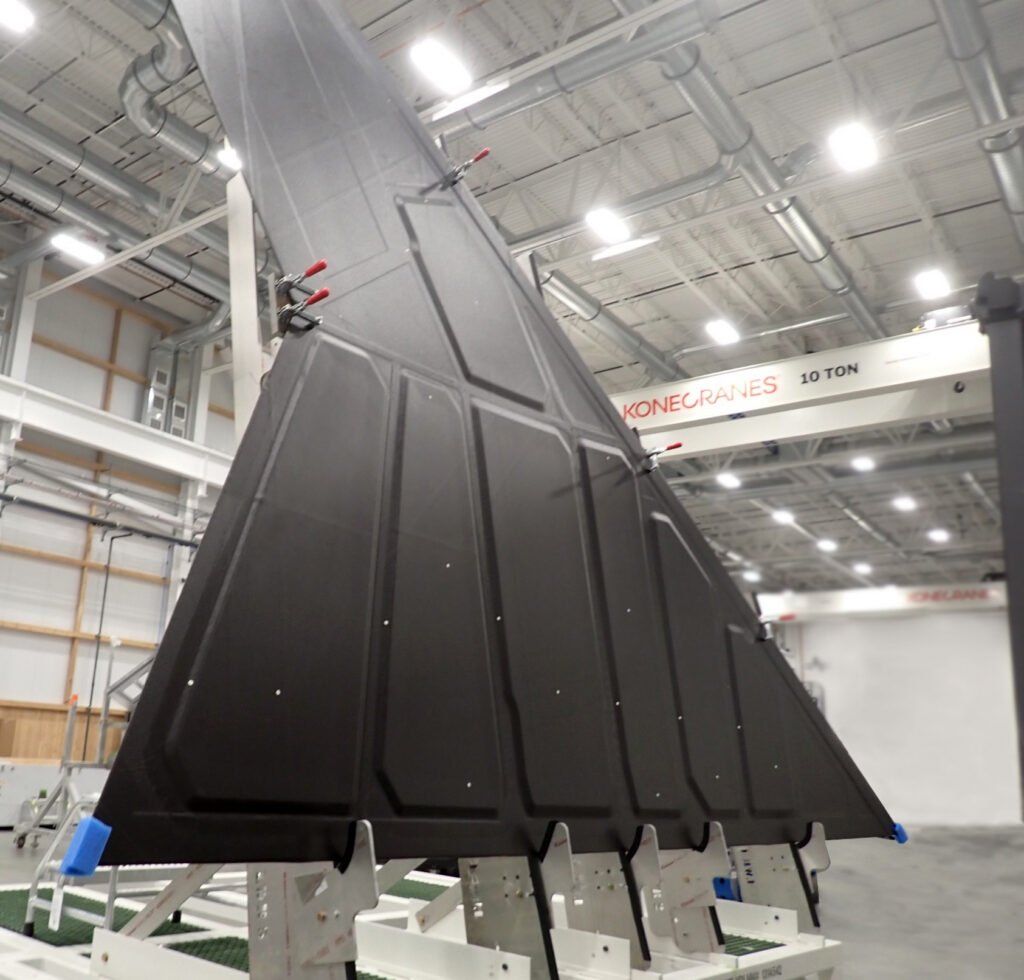
Production of the first prototype is continuing, and the company has shown images of the airframe being assembled.
The development timeline has moved at an accelerated pace. The team went from an initial concept sketched at an early stage to wind-tunnel validation in just two months. The first digital build was completed within six months, while the first part release followed eight months after the program began.
Manufacturing process designed to cut costs
To simplify production and reduce costs, Lockheed Martin is using a method known as “minimal tooling determinate assembly.”
Fehlen compared the approach to assembling modular furniture, with components designed to be fitted together quickly and accurately while minimizing manual intervention.
The technique is intended to reduce the amount of hands-on labor required and increase the percentage of components assembled correctly on the first attempt. According to the company, the process has reduced the labor hours needed to build the aircraft by as much as 80 percent in some cases.