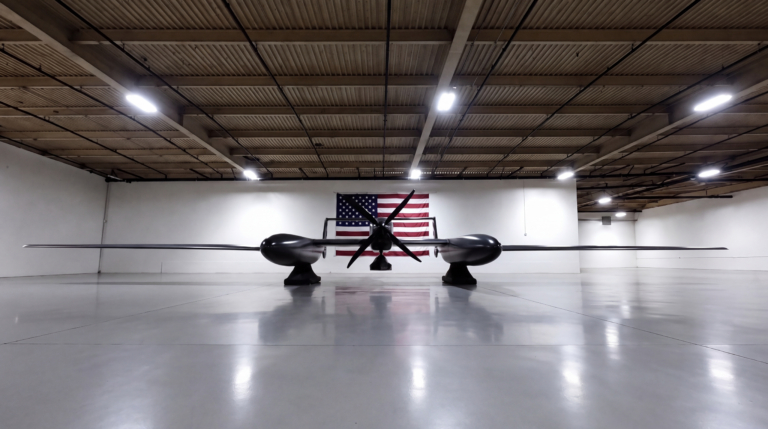
Emerging drone manufacturer Swarm Aero has entered the competition to replace the MQ-9A Reaper with Gamera, a twin-fuselage unmanned aircraft designed for long-duration missions and extreme-range strike operations.
The company unveiled a full-scale model of the aircraft at the Air and Space Forces Association conference. Swarm Aero says Gamera will feature a wingspan of approximately 72 feet, an unrefueled range of up to 9,000 nautical miles—roughly 10,357 statute miles—and seven hardpoints for weapons and other mission equipment.
An unconventional design that trades stealth for range
Unlike the MQ-9A Reaper and most long-endurance drones currently in service, Gamera does not use a conventional central fuselage. Instead, it features two elongated fuselages positioned in parallel on either side of the aircraft’s centerline.
Company executives say the configuration was selected to maximize operating range. Swarm Aero deliberately avoided extensive stealth features and complex protective systems, focusing instead on a simple, producible aircraft optimized for extreme-distance missions.
“We chose to move away from the conventional view that an aircraft designed to strike critical targets at long range must be built around stealth technology and extensive survivability measures,” said Oliver Palmer, the company’s co-founder and chief revenue officer.
Gamera enters the Massed Modular Aircraft competition
Swarm Aero is offering Gamera for the Pentagon’s Massed Modular Aircraft program, or MMA. Led by the Defense Innovation Unit and the U.S. Air Force, the initiative seeks to develop a cheaper and more attrition-tolerant replacement for the MQ-9A Reaper.
The need for such a platform has become more pressing following significant Reaper losses in recent conflicts. Depending on its configuration, an MQ-9A can cost as much as $50 million.
The MMA program is intended to deliver a major reduction in acquisition costs. Air Force officials are targeting a unit price of approximately $10 million and have directed the program team to accelerate development and fielding.
Company promises to beat the Pentagon’s price target
Swarm Aero is not the first company to enter the MMA competition. General Atomics, the manufacturer of the MQ-9A Reaper, has already unveiled its own proposal, known as Wildfire.
Swarm executives nevertheless argue that Gamera can outperform the Air Force’s cost target and that the company will remain highly competitive on price.
Chief Executive Officer Peter Kalogiannis said that lowering the cost will not depend on a single breakthrough. Instead, it will require a sustained effort applied to every stage of the aircraft’s design and production.
Modularity built around different missions
Gamera has been designed to allow payloads to be exchanged quickly and hardware and software to be upgraded with minimal disruption.
The MMA program requires a payload capacity of at least 2,800 pounds, or approximately 1,270 kilograms. Swarm Aero says Gamera meets the requirement when payload and range are considered together.
Depending on mission needs, operators could increase the weapons load while accepting a shorter range, or reduce the payload and use the saved weight for additional fuel and longer-distance operations.
Mature systems combined with selective innovation
Although a U.S. Air Force official previously suggested that the winning MMA aircraft would not necessarily require cutting-edge technology, Swarm Aero argues that the right balance will come from combining proven systems with targeted innovation.
The company has partnered with Honeywell to power the aircraft with a TPE331 turboprop engine. Swarm also sees significant opportunities for innovation in avionics and composite aerostructure manufacturing.
Autonomy software and drone-swarm control
Swarm Aero’s strategy extends beyond the aircraft itself. The company is developing its own autonomy suite, called Legion.
Swarm was also selected alongside two other vendors for a Defense Innovation Unit program focused on prototyping command-and-control systems for coordinating drone swarms under the Replicator initiative.
First flight planned for next year
Gamera is currently under construction, and development of the aircraft began in 2022. The company plans to conduct the first flight during the second half of next year.
Swarm Aero says that years of investment in manufacturing have positioned it to move rapidly into volume production if the Pentagon selects Gamera for the MMA program.
The company also plans to pursue civil applications over the longer term, including cargo logistics and aerial firefighting.
For now, however, Swarm’s immediate priority is securing a contract with the U.S. Department of Defense.