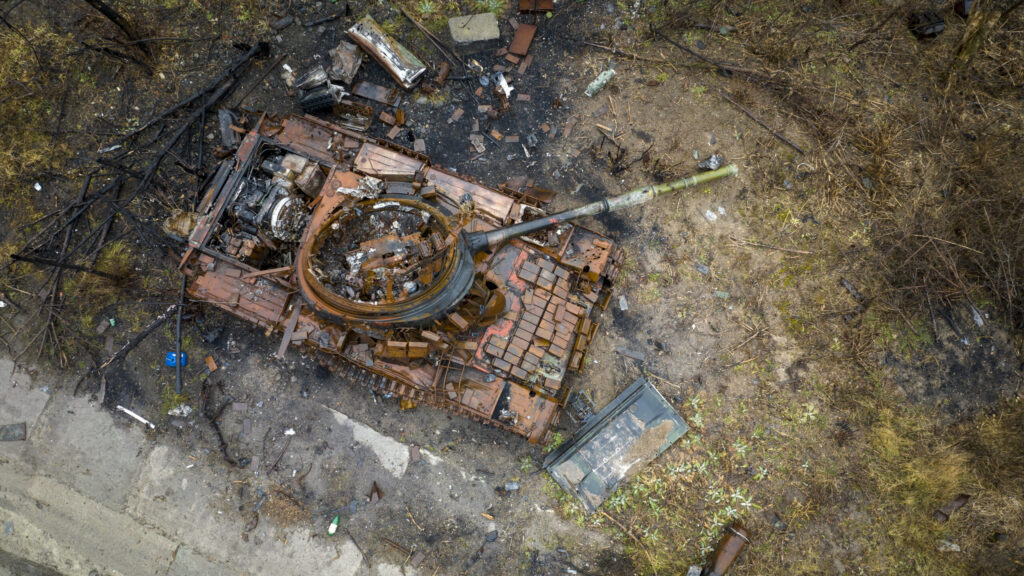
The war in Ukraine has exposed a harsh vulnerability at the heart of modern armored warfare: a low-cost first-person-view drone can stalk a tank from above, bypass its heaviest armor and strike the turret roof—often the vehicle’s most exposed and fragile surface.
As Western militaries race to respond, China’s People’s Liberation Army is drawing its own conclusions. PLA planners have watched drones and steep-angle attacks devastate armored vehicles in recent conflicts. Their answer is taking shape as a broad effort to redesign how tanks survive in a battlefield increasingly dominated by threats from above.
A New Weak Point Above the Turret
In early 2025, Chinese state media showcased one of the country’s emerging responses. Footage from a Norinco test facility showed a tank equipped with the GL-6 active protection system intercepting an incoming threat descending from above while engaging another target approaching from the side.
The demonstration underscored the system’s intended role: defending armored vehicles against high-angle attacks launched by drones, rockets, missiles and loitering munitions, including scenarios in which threats arrive almost simultaneously from the air and the ground.
The GL-6, however, appears to be only one element of a much broader defensive architecture.
From Individual Tanks to Networked Combat Formations
At the 2024 Zhuhai Airshow, Norinco presented an “intelligent combined brigade” concept built around networked warfare. The model places armored vehicles within a wider combat system that includes reconnaissance drones, electronic-warfare units and counter-drone capabilities.
Rather than relying solely on a tank’s armor or onboard defenses, the concept seeks to detect, track and disrupt threats before they reach the vehicle. Sensors, jamming systems, unmanned platforms and active protection systems would operate as interconnected parts of a single defensive network.
That approach reflects a growing view within China’s military establishment: the drone threat cannot be solved by adding one device to one tank. It requires coordination across the entire formation.
Layered Protection Against Drone Swarms
Recent PLA studies have pointed toward a similar strategy. Researchers examining the vulnerability of mobile formations to unmanned aerial vehicle swarms have advocated combining early warning, electronic countermeasures, kinetic interception, camouflage and decoys.
Chinese defense researchers are also studying the technologies needed to make such systems work, including improved detection, threat prediction and interception. Their analyses warn that cheap drones, coordinated swarms and precision-guided weapons could overwhelm expensive defensive systems through sheer volume.
That concern is encouraging renewed interest in lower-cost terminal defenses capable of absorbing saturation attacks. In practice, this could mean combining active protection systems with electronic warfare, camouflage, smoke, decoys and physical barriers rather than expecting a single technology to stop every incoming threat.
The emerging concept of “smart armor” is therefore less about a revolutionary vehicle component than about a more connected and responsive approach to battlefield survivability.
Simple Add-Ons Still Have a Role
For the PLA, the most urgent issue may not be identifying the most sophisticated protection technology. It may be deploying effective measures quickly enough to influence combat units in the field.
As in Ukraine, Chinese forces have shown interest in roof screens, cage-like structures, localized armor reinforcement and other improvised modifications. These adaptations have also shaped crew procedures and battlefield behavior.
Recent PLA training exercises have emphasized hiding armored vehicles in roadside depressions, covering them with camouflage nets, concealing or removing track marks and using smoke to obscure movement during tactical operations.
Such measures may appear basic, but they serve the same purpose as overhead screens and add-on armor: they buy time. By disrupting an attacker’s targeting process, they force drones and anti-armor teams to overcome additional obstacles before delivering a precise strike.
A tank protected by hard-kill interceptors, concealment, smoke and modular barriers may be more difficult to locate, track and destroy—even without a completely new vehicle design.
Turning Battlefield Improvisation Into Standard Equipment
Chinese military analysts are increasingly focused on transforming temporary battlefield adaptations into durable and standardized protection systems.
That process involves difficult trade-offs. External cages, wire barriers and composite screens can improve survivability, but they may also reduce visibility, restrict weapon movement, interfere with mobility and complicate maintenance and logistics.
A PLA assessment published in April 2026 examined several foreign approaches, including protective cages, wire barriers and composite screens, while highlighting their operational drawbacks. Another analysis published in September explored how such measures could be incorporated more seamlessly into routine armored operations.
Russian experience has drawn particular attention. After observing combat feedback, Russian manufacturers began integrating physical and electronic anti-drone measures into newly produced tanks rather than treating them as temporary field modifications.
Chinese reporting on protective materials has similarly emphasized lighter composites and modular armor packages designed to complement active and electronic defenses.
The Objective: Make Overhead Attacks Harder and More Expensive
For the United States and its allies, the central question is not whether China has developed a perfect shield against FPV drones. It has not.
The more important question is whether PLA armored units can make top-attack strikes less predictable, less affordable and less likely to succeed.
Even limited improvements could have significant consequences. A tank that is harder to detect, more difficult to target and better protected during the final moments of an attack may force an opposing force to use larger drone salvos, more complex tactics and multiple attack directions.
No Single Layer Can Close the Threat
Chinese military researchers acknowledge that every defensive layer has weaknesses. Small drones remain difficult to detect, engagement windows are often extremely short and successful interception can be expensive.
The spread of fiber-optic-controlled drones and autonomous systems is also reducing the effectiveness of traditional electronic jamming. These platforms can resist radio-frequency interference and continue operating even in heavily contested electromagnetic environments.
Active protection systems, roof barriers, camouflage, smoke and localized reinforcement may therefore work best by complicating an attack rather than guaranteeing a clean defense. They can force anti-armor teams to coordinate larger salvos, use deception, conduct closer reconnaissance and launch attacks from multiple directions.
That, in turn, can expose support vehicles, communications nodes and other elements that make drone operations possible.
Ukraine has demonstrated that drone-dominated battlefields reward rapid adaptation, layered attacks and saturation. Taiwanese military analysts have interpreted China’s public displays of tanks equipped with active protection systems in a similar way—as evidence that the PLA is preparing for asymmetric tactics centered on drones and anti-tank weapons.
China’s Armor Is Entering a New Defensive Era
Chinese military reporting does not indicate that the PLA has solved the problem of drone-era anti-armor warfare. It does show, however, that China is reconsidering how armored forces must operate at the front.
The emerging model combines active protection, overhead shielding, modular reinforcement, camouflage, smoke, electronic warfare and improved coordination between individual vehicles and the wider formation.
The decisive test will be whether these ideas can move rapidly from demonstrations and training exercises into operational units. If they do, future PLA armored formations may no longer present the easy overhead targets that drones have found across recent battlefields.
The drone age has not brought armored warfare to an end. It has changed the conditions for survival—and China is moving to adapt before that lesson becomes a lasting battlefield disadvantage.