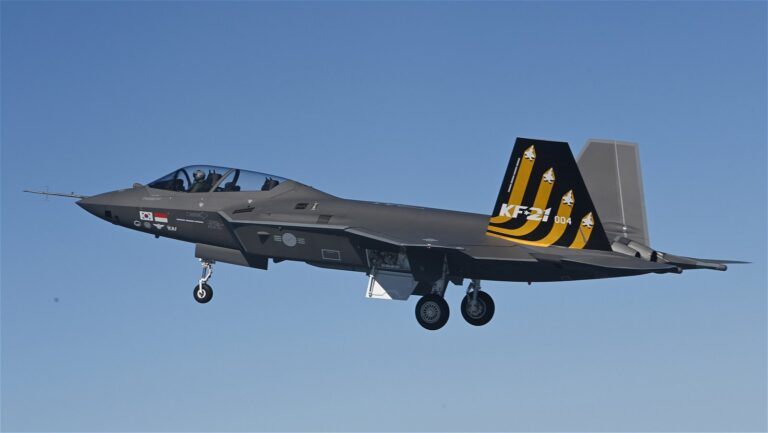
South Korea has formally inducted its first domestically developed fighter jet into operational service, marking a major achievement for the country’s defense industry and its ambition to build advanced military aircraft independently.
The first Korea Aerospace Industries KF-21 was transferred to the Republic of Korea Air Force and flown from KAI’s facilities in Sacheon to its new operating base at Yecheon.
First Fighter Delivered to the Air Force
The delivery marks the beginning of the KF-21’s transition from a development program to an operational weapons system. South Korean military officials described the aircraft’s arrival as the result of years of technical challenges, testing and industrial development.
The ROKAF’s 156th Fighter Squadron will become the first unit to operate the new aircraft. The squadron was reestablished earlier this year after being disbanded in 2012.
South Korean defense officials said the delivery represents a turning point in the country’s drive for self-reliant defense capabilities. The achievement demonstrates that South Korea can design, develop and mass-produce an advanced fighter jet without relying entirely on foreign suppliers.
Block 1 Focuses on Air Combat
South Korea has ordered 40 KF-21 aircraft in the initial Block 1 configuration. These jets will primarily perform air-to-air missions, strengthening the country’s ability to defend its airspace against regional threats.
A more capable Block 2 version is already under development. The upgraded aircraft is expected to introduce expanded air-to-ground capabilities, allowing the KF-21 to conduct a broader range of strike missions.
South Korean media have reported that the Air Force is considering the acquisition of an additional 80 Block 2 aircraft, potentially bringing the country’s total planned fleet to 120 fighters.
Flight Testing Completed Earlier This Year
The KF-21 was publicly unveiled at a ceremony held at KAI’s Sacheon facility in March. The company completed the aircraft’s flight-test program in January, clearing the way for the first production aircraft to enter military service.
The fighter is classified as a 4.5-generation combat aircraft. It incorporates modern avionics, advanced sensors and a combination of South Korean and Western weapons.
Among its planned armament are the Korean GPS-guided glide bomb, known as KGGB, and the European-made MBDA Meteor beyond-visual-range air-to-air missile. This weapons mix is intended to give the KF-21 both long-range air-combat capabilities and precision-strike potential.
Export Ambitions Move to the Fore
With the aircraft now entering service at home, KAI is turning its attention increasingly toward foreign markets.
Indonesia has shown interest in purchasing KF-21 fighters directly from South Korea after abandoning earlier plans to manufacture the aircraft domestically. A successful export deal would strengthen the program’s financial foundation and help establish South Korea as a significant supplier in the international fighter market.
The KF-21’s entry into service therefore carries importance beyond the Korean Peninsula. It marks not only the arrival of a new fighter for the ROKAF, but also South Korea’s emergence as an increasingly independent producer of advanced combat aircraft.