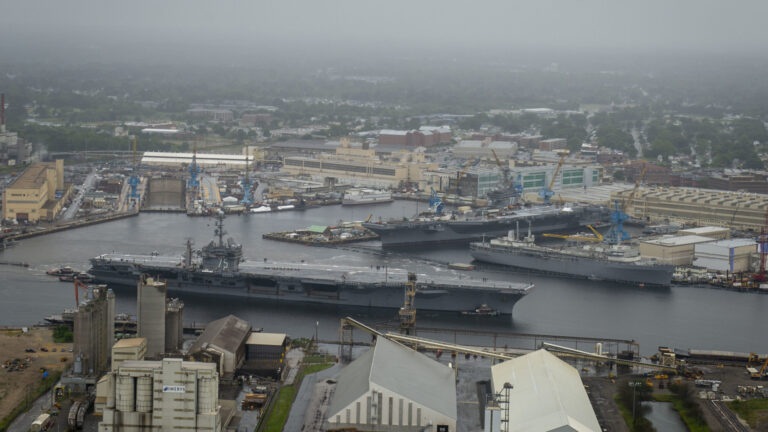
The U.S. Navy’s plan to modernize its four government-owned shipyards could require nearly ten times the funding originally projected and take decades longer to complete, according to a new assessment by the Government Accountability Office.
The Shipyard Infrastructure Optimization Program, launched in 2018, was designed to rebuild dry docks and upgrade standard equipment at naval shipyards in Virginia, Maine, Washington and Hawaii. These facilities perform critical maintenance on the Navy’s nuclear-powered aircraft carriers and submarines.
Costs and Timelines Surge
When the program began, the Navy estimated that the work would take approximately 20 years and cost about $21 billion. The latest GAO assessment paints a far more difficult picture, projecting that the effort could last 50 years and cost as much as $200 billion.
The watchdog agency concluded that the original estimate failed to account for several major expenses. Rising commodity prices, additional construction requirements and seismic vulnerabilities at Washington state’s Puget Sound Naval Shipyard have all contributed to higher costs and extended schedules.
The earthquake-related concerns require further structural upgrades and construction, adding another layer of complexity to an already extensive modernization effort.
Scope of the Program Continues to Expand
The shipyard initiative has also grown beyond its initial scope. Since 2018, the Navy has added new construction and repair projects, while redesigning portions of the program based on lessons from work already in progress.
The cost increases are particularly significant at the Portsmouth and Pearl Harbor shipyards. Combined expenses for dry-dock projects at the two facilities have risen by more than $2.5 billion since the Navy first sought congressional funding for them.
The GAO said the Navy’s planning process has taken years longer than expected, largely because of the program’s changing requirements and the numerous technical, financial and logistical challenges involved in rebuilding the facilities.
Congress Lacks a Consolidated Financial Picture
The report also criticized the absence of a requirement for the Navy to provide Congress with a single, comprehensive account of the program’s finances and risks.
Instead, lawmakers receive updates covering individual aspects of the initiative. The GAO warned that this fragmented reporting makes it difficult to determine how much has already been spent, how much additional funding will be required and which risks could further delay the work.
The agency recommended that Congress require the Navy to submit a standardized annual report detailing the program’s costs, progress, remaining funding needs and major risks.
Without such information, lawmakers could make major decisions based on incomplete data, potentially exposing taxpayers to billions of dollars in unanticipated costs while weakening oversight of a program expected to continue for decades.
Navy Expects Faster Maintenance Turnarounds
Despite the escalating price and schedule, the Navy argues that the modernization effort is essential to improving the availability of its nuclear-powered fleet.
Officials have projected that the completed upgrades could improve aircraft-carrier maintenance efficiency by approximately 10 percent and submarine maintenance efficiency by around 15 percent.
A typical submarine maintenance period lasts between 25 and 36 months. Navy officials have said that the infrastructure improvements could shorten those periods by roughly three months.
Those gains would be strategically important as the Navy attempts to keep its carrier and submarine fleets operational amid growing maintenance demands and pressure on the service’s overall force structure.
A Modernization Effort Measured in Generations
The scale of the revised projections underscores the difficulty of rebuilding the Navy’s shipyard infrastructure while those same facilities remain responsible for maintaining the fleet.
What began as a two-decade, $21 billion modernization plan could now become a 50-year undertaking costing up to $200 billion. The challenge for the Navy and Congress will be to balance the need for urgent infrastructure improvements with tighter cost control, transparent reporting and sustained oversight over a program likely to span multiple generations of military planners.