



Modernizing military aviation involves more than selecting a capable aircraft at a competitive price. Armed forces need a partner that can tailor aircraft to specific operational requirements, deliver on schedule and within budget, and provide maintenance throughout the platform’s service life.
Bombardier Defense’s approach combines the company’s aircraft with engineering expertise, modification services and collaboration with mission-system providers. The aim is to turn business jets into platforms configured for a range of military missions.
Adaptable platforms for demanding missions
The range, speed, availability and operating costs of business jets can make them suitable for a variety of airborne roles. Bombardier aircraft can be equipped with advanced radars, sensors and other mission payloads for intelligence, surveillance and reconnaissance (ISR), signals intelligence (SIGINT), and airborne early warning and control (AEW&C).
Their speed and range support broad-area coverage and rapid deployment to different operating theaters. Aircraft can be reassigned or moved to new areas on short notice, reducing dependence on fixed bases and geographic constraints.
Other potential roles include maritime patrol, medical evacuation and strategic government transport. With interiors designed for customization and rapid conversion, one aircraft can perform multiple functions. Systems can also be upgraded as threats and technologies evolve, while crewed aircraft can complement emerging capabilities, including uncrewed vehicles.
A record of service with the U.S. military
Bombardier Defense has supplied Challenger and Global aircraft for government and military missions for decades. These platforms have accumulated thousands of hours in operational theaters. Two U.S. programs illustrate their use in specialized roles.
The U.S. Air Force operates nine Global aircraft as part of the Battlefield Airborne Communications Node (BACN) program. Designated E-11A and often called “Wi-Fi in the sky,” the aircraft act as high-altitude communications gateways. They help relay voice and tactical data between air and ground forces, including in areas where mountains, difficult terrain or distance can disrupt communications.
Another example is the U.S. Army’s HADES program, which selected the Global 6500 as its aircraft platform. The first aircraft was delivered last year, with additional prototypes in development and deployments planned to begin late this year. The program is intended to transform the Army’s airborne reconnaissance capabilities through a platform designed to collect and deliver intelligence from stand-off ranges.
The Global 6500’s altitude, endurance, payload capacity and adaptable architecture are central to its HADES configuration. The aircraft is designed to detect, identify and track targets at a distance in contested environments, while limiting unnecessary risks to crews and aircraft. Its capabilities can support multidomain operations, long-range precision fires and joint-force coordination.
Industry partnerships and mission-specific configurations
The aircraft itself is only one part of the solution. Integrating mission technologies requires cooperation among the manufacturer, military customers and system providers. Bombardier Defense works with companies in the defense sector, including L3Harris, SNC, Northrop Grumman and Saab, to integrate technologies that turn business jets into specialized platforms.
Support can be tailored to customer requirements, ranging from aircraft delivery to engineering, modifications, technical-data licensing and maintenance. The emphasis is on configuring each offering for its intended mission rather than applying a single standard solution.
The company’s experience with specialized aircraft is reflected in a global fleet that has logged more than three million flight hours and serves over 170 operators in nearly 50 countries. Its support network includes more than 100 locations worldwide.
Maintenance as part of operational readiness
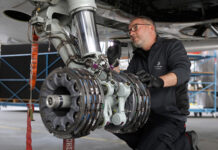
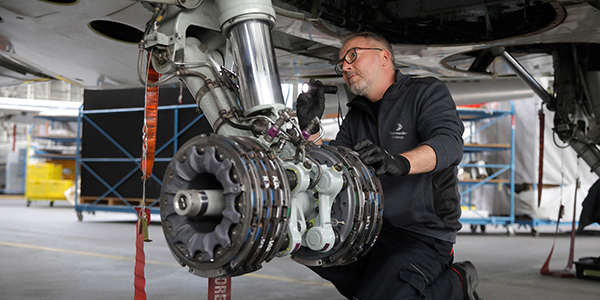
Aircraft availability depends not only on performance but also on access to parts, maintenance and technical assistance. Bombardier offers cost-per-flight-hour service programs, spare parts, and scheduled and unscheduled maintenance.
Operators can access technical support and assistance for aircraft grounded by maintenance issues through the company’s customer response center. Bombardier’s global parts inventory is valued at $1.5 billion. The company says its original-equipment-manufacturer expertise enables it to support its aircraft and, where required, provide specialized assistance for modified platforms.
Smart Services programs are designed to make maintenance costs more predictable—a useful feature for government customers planning long-term budgets.
A partnership that extends throughout the mission
By combining aircraft, engineering, industrial collaboration and continuing support, Bombardier Defense aims to offer more than an airframe. Its approach emphasizes adapting platforms to operational needs and supporting them throughout their service lives, as missions and technologies continue to evolve.