







As strategic rivalries intensify across the Indo-Pacific and China’s naval footprint expands toward vital shipping routes, Australia is fundamentally re-engineering its ground forces. The establishment of the Australian Army’s Littoral Manoeuvre Group (LMG) signals a decisive shift toward maritime mobility, aiming to safeguard island approaches and littoral corridors across vast oceanic distances.
A Doctrinal Shift: Securing Chokepoints and Island Corridors
The creation of the group directly operationalizes the mandates of Australia’s 2024 National Defence Strategy, which tasked the army with becoming an agile, littoral-focused formation armed with long-range land and maritime strike capabilities. Recent large-scale amphibious drills conducted alongside Indonesian forces highlighted the unit’s intended mission profile: establishing rapid-deployment screening forces and securing vital maritime chokepoints in coordination with regional allies.
Defense scholars note that this concept hearkens back to Australia’s hard-learned lessons in amphibious combined-arms warfare during World War II. Given the geography of the Southwest Pacific, deploying land forces across dispersed archipelagos requires an organic amphibious lift capability rather than static mainland posture.
Heavy Landing Craft: Power Projection on a New Scale
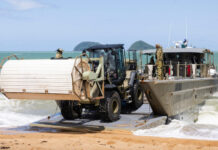
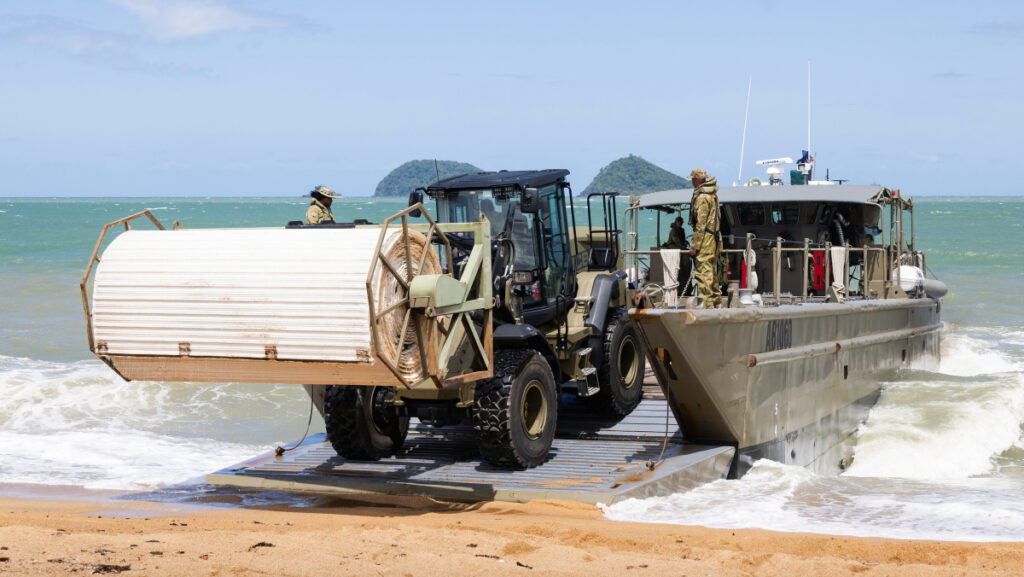
The tactical backbone of the LMG will rest on three dedicated landing craft battalions. Each battalion is slated to operate four Landing Craft Medium (LCM) and two Landing Craft Heavy (LCH) vessels, built under domestic shipbuilding agreements.
The performance specifications represent a historic leap for Australian ground mobility. The heavy landing craft will be capable of ferrying 200 troops alongside either six M1 Abrams main battle tanks or nine Redback infantry fighting vehicles. Working in tandem with the Royal Australian Navy’s major amphibious hulls, these new craft provide the army with a persistent, independent maneuver capability across forward island archipelagos.
The Fiscal Hurdle: Navigating AUKUS Budget Pressures
While analysts view the littoral restructuring as the correct strategic response to Indo-Pacific realities, execution risks remain tied to fiscal constraints. Despite national pledges to lift overall defense outlays toward three percent of GDP, the staggering long-term capital required for the trilateral AUKUS nuclear submarine program has triggered broad defense investment reviews.
Maturing new landing craft capabilities and scaling up to move entire battalion-level task forces will take sustained operational experimentation. Defense observers caution that unless funding is shielded through the execution pipeline, the Littoral Manoeuvre Group could take years to achieve full operational capability.