Marines and Soldiers operating manned missile batteries face significant risks from counter-battery fire immediately after launching their systems, as these platforms are easily detected by enemy sensors. Autonomous, driverless technology presents a strategic solution to mitigate this multidimensional threat.
For instance, an enemy warship equipped with advanced sensor capabilities can quickly identify the trajectory of an anti-ship ballistic missile and respond with counter-fire. Alternatively, a simple first-person-view quadcopter may relay the location of a missile battery back to enemy forces for immediate retaliation.
Scott Sanders, a former Marine Special Operations Officer and chief growth officer for Forterra, highlighted the perils of operating near weapon systems in modern combat scenarios. “Joining a HIMARS battery or anti-ship missile launcher is risky,” he said. “If counter-battery fire is not evaded quickly, the consequences could involve significant financial losses in hardware and, more critically, the lives of Marines who are irreplaceable.”
To address this vulnerability, there is an urgent need for mobile launch systems capable of firing and repositioning swiftly, even before a missile strikes its target. While field-based artillery teams have undergone extensive training akin to NASCAR pit crews, the adversaries’ advanced capabilities in the electromagnetic spectrum continue to render these positions vulnerable.
The integration of autonomy into these platforms allows for faster maneuvering and firing capabilities than crewed systems can achieve, thereby enhancing safety for personnel at standoff distances. Sanders noted, “Robots can displace faster, reducing the risk to forces engaged in enemy fire.”
Beyond safeguarding lives, autonomous systems can be utilized across various operational scenarios, including counterterrorism, search and rescue, logistics and supply, surveillance, urban warfare, border security, and more. These systems also extend their utility to any platforms that emit electronic signatures, as active radar systems are easily detectable and pose significant risks when activated. This is why missiles like the AGM-88 HARM (High-speed Anti-Radiation Missile) are vital assets for the U.S. military and allied forces.
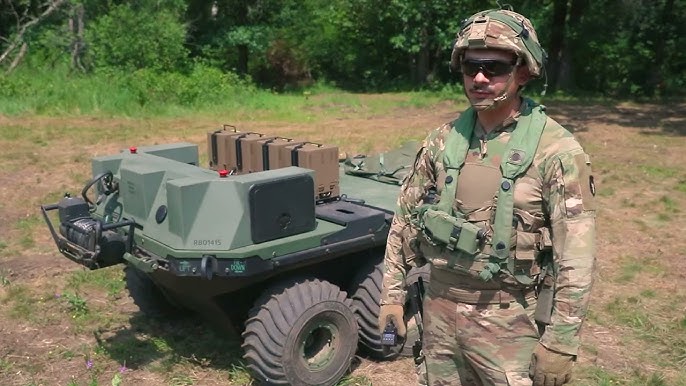
Currently, Forterra is leading the charge in deploying self-driving systems for the Marine Corps’ Remotely Operated Ground Unit for Expeditionary (ROGUE) Fires, part of the Navy Marine Expeditionary Ship Interdiction System program (NMESIS). This system, built on an unmanned ground vehicle platform, enhances ground-based anti-ship missile operations.
Advancing Autonomy for USMC and Army Platforms
The Marine Corps and Army are increasingly recognizing the advantages of robotic and autonomous systems in improving operational effectiveness and safeguarding personnel. As stated in the Army Futures Command Concept for Fires 2028, “The potential benefits of autonomous/robotic platforms to the Army may prove to be advantageous to all warfighting functions’ mission sets,” including enhanced logistical support, targeting capabilities, and the operational ability to expand across larger areas without exposing Soldiers to danger.
While there are numerous entities claiming to address the challenges of ground autonomy, Forterra stands out for its reliability and scalability in implementing autonomy solutions over the past two decades. As a leading provider of autonomous systems for ground movement, Forterra has built a robust foundation to protect front-line troops and facilitate civilian operations within the industrial sector. In September, they secured $75 million in Series B funding to accelerate the deployment of their AutoDrive autonomous driving system for defense and industrial clients.
Zach LaCelle, head of product for Forterra, claimed, “We have integrated autonomous technology on more defense vehicles than any other company globally over the last 20 years,” which positions them uniquely within the industry to navigate the complexities of vehicle and sensor integration.
Capitalizing on Program Synergies
The robotic initiatives underway allow the Department of Defense (DoD) to bolster surveillance, reconnaissance, and firepower capabilities without increasing personnel risk. However, variances exist among programs with distinct requirements and acquisition strategies. Each project falls under different program offices, such as the Army PEO Soldier and Marine Corps Systems Command, which may result in overlaps in capabilities within robotic vehicles or logistical support vehicles.
This raises pertinent questions regarding synergies, potential cost savings, technology sharing, and overall efficacy through coordinated autonomy programs across different offices and services that share similar goals and technology platforms.
LaCelle stated, “We are uniquely positioned to engage across various programs, leveraging our extensive experience in autonomy to inform these initiatives.”
Ready for Immediate Impact
Autonomous systems in ground operations are primed for immediate deployment, promising to enhance the safety and effectiveness of Marines and Soldiers in combat. The dual-use nature of these technologies allows the military to accelerate capability delivery while reducing development costs. Forterra is at the forefront of this transformation, providing innovative solutions that protect troops across diverse combat scenarios.
“This isn’t just an academic exercise,” Sanders asserted. “This technology is operational, reliable, and has been honed over 20 years to ensure functionality and scalability.”
With more than 100 autonomous vehicles successfully deployed, achieving a cumulative 400,000 operational miles.