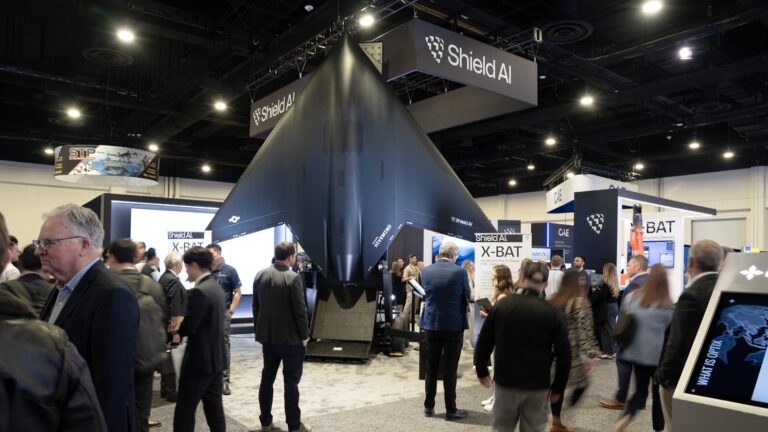
Shield AI and the US Navy have announced a significant combined investment of $400 million aimed at accelerating the development of the X-BAT, a vertical takeoff and landing (VTOL) unmanned aerial system poised to redefine naval power projection capabilities.
A Strategic Financial Commitment to Cutting-Edge Tech
A fresh $300 million funding milestone has been secured, structured through a $150 million modification to an existing Pentagon agreement, matched by an equivalent $150 million investment of private capital from Shield AI. This latest influx builds upon a previously announced $100 million in funding, bringing the total joint effort dedicated to the X-BAT program to $400 million.
Bridging Naval Operational and Logistical Gaps
The initiative is central to the Runway Independent Maritime Expeditionary Strike (RIMES) effort, which seeks to field a drone capable of launching long-range strikes without the need for large flight decks or extensive ground infrastructure. This capability is critical for naval surface combatants, such as Arleigh Burke-class destroyers, which face significant constraints in operational endurance due to limited missile magazine depth and challenging at-sea munition replenishment.
The X-BAT is engineered for high-performance operations, featuring a range exceeding 2,000 nautical miles and the ability to carry 1,000-pound munitions. It is explicitly designed to integrate seamlessly into carrier air wing missions, enhancing combat power without disrupting or compromising existing high-tempo naval operations.
Accelerated Development and Testing Milestones
To minimize development risk and ensure rapid progression, the company is employing a parallel development strategy—concurrently advancing aircraft construction, mission systems, ship suitability integration, and production planning. Production is slated for the Seattle area, with flight testing scheduled to commence in Kansas later this year. Marketed as the „world’s first AI-piloted VTOL fighter jet,” the X-BAT measures 26 feet in length with a 39-foot wingspan, representing a fundamental shift in the US Navy’s ability to project force from limited-footprint maritime platforms.