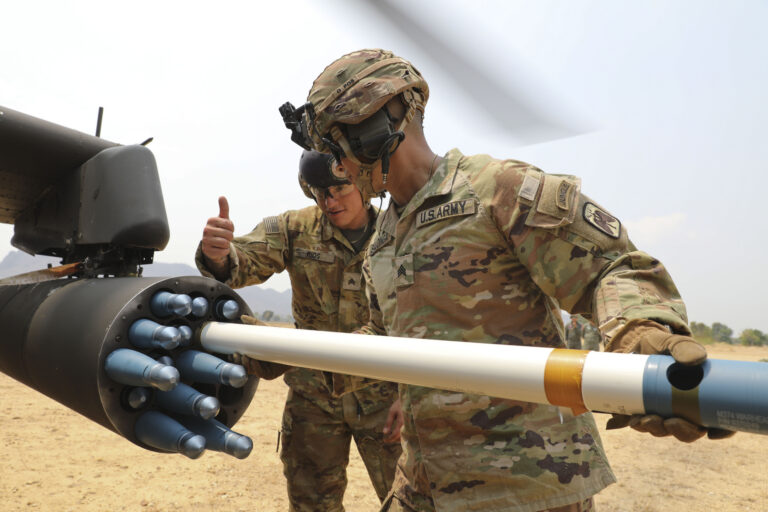
The United States Army is accelerating its munitions production by awarding prototype agreements to four key companies to bolster the supply of Hydra-70 rockets. Commonly deployed by AH-64 Apache helicopters, these rockets are a cornerstone of air-to-ground operations, and the new strategic move is designed to ensure industrial readiness and uninterrupted lethality.
Diversifying suppliers: The Pentagon’s strategy to eliminate logistical bottlenecks In a bid to expand the industrial base, the service has selected Firehawk, iRocket, Nammo Perry, and Albers to supply M151 high-explosive fragmentation warheads. By utilizing Other Transaction Authority (OTA) agreements, the military aims to foster competition and create surge capacity. This ensures that the Army can swiftly meet emergent mission requirements without being hindered by traditional supply chain constraints.
Innovation under pressure: Modernizing technical data packages for air-to-ground arsenals These agreements grant vendors the unique opportunity to improve the government-owned Technical Data Package (TDP). Within 18 months, each company is expected to deliver 24 prototype warheads alongside a modernized design plan. Updating these blueprints is crucial for integrating modern manufacturing approaches into the production of the 70mm munitions, which can be launched from both aircraft and ground-based platforms.
Securing the industrial flank: From prototype to mass production While General Dynamics Ordnance and Tactical Systems has been the long-standing supplier for the program, the addition of new players like Firehawk—which recently established a massive production campus in Mississippi—signals a shift toward rapid scalability. Should these prototypes prove successful, follow-on agreements may broaden the effort to include other variants of the Hydra-70 family, securing the munitions pipeline for the future.