Startup Joby Aviation has officially announced the acquisition of military technology firm Resonant Sciences, a $500 million strategic move that transforms the Ohio-based company into the cornerstone of its new defense division. This acquisition marks a clear pivot toward Pentagon needs at a time when the civil air taxi market faces regulatory hurdles.
A colossal investment for technological supremacy
The deal involves $450 million in cash and $50 million in stock, with completion expected in the first half of 2027. Through this merger, Joby gains access to secure infrastructure and cleared personnel, essential for managing classified military contracts that the company could not previously handle independently.
Pivoting toward defense: Beyond the limitations of electric propulsion
While Joby initially focused on pure electric aircraft, Air Force testing revealed range limitations for combat missions. Integrating Resonant Sciences’ expertise in RF systems and electronic countermeasures will enable the development of autonomous and hybrid platforms capable of meeting new defense priorities focused on lower costs and increased resilience.
The revolution of affordable weaponry: Boeing and Northrop Grumman rewrite the rules of modern warfare
Aerospace giants have unveiled new technologies aimed at drastically reducing the costs of precision munitions, responding to Pentagon pressure to deliver high volumes of weaponry at sustainable prices. In the context of current global conflicts, these innovations promise to eliminate bottlenecks in mass production.
Technology breaking the bottlenecks: Boeing launches the Ultra Low-Cost Seeker Boeing presented the Ultra Low-Cost Seeker (ULCS), a radar sensor that guides missiles to their targets using commercial components modified for military use. This system is designed to replace expensive technologies that have slowed Patriot interceptor production, offering a solution for large-scale air and maritime strikes with significantly lower production costs.
Raid Hunter: Lethal precision at bargain prices against drone swarms
Northrop Grumman unveiled the Raid Hunter system, based on a 50mm gun capable of destroying drones and cruise missiles with surprising economic efficiency. Thanks to sensor-guided maneuverable munitions, the system no longer needs to fire massive bursts, with each shot costing only a few thousand dollars—a sustainable alternative to million-dollar interceptor missiles.
The hypersonic supremacy of the future: DARPA seeks radical ideas for the next generation of missiles
Pentagon research agency DARPA has issued a call to industry for revolutionary concepts to redefine hypersonic weapons. The goal is to create a cruise missile capable of penetrating the most advanced adversary air defense systems, ensuring United States technological superiority.
The leap from evolution to revolution: Beyond the limits of the scramjet DARPA believes current hypersonic technologies offer only minor improvements and is calling for a quantum leap in speed, range, and altitude. It seeks radical subsystems, from high energy density fuels to extreme-temperature resistant materials, to enable affordable mass production that bypasses traditional, overly expensive, and complex manufacturing processes.
A paradigm shift in military robotics: The US Army cedes software control to industrial genius
The United States Army has radically recalibrated its strategy for autonomous vehicles, abandoning plans to internally develop a universal software backbone. Military officials have decided to let private industry deliver complete solutions tailored to specific mission needs, recognizing the massive technological lead of the private sector.
The end of internal monopoly: Private companies take the reins of autonomy The ARCS program, which aimed for centralized Army software, has been halted to avoid competing with superior industrial innovations. The new approach encourages firms to organize into teams delivering integrated autonomy packages and robotic platforms, allowing the military to focus on the role of strategic integrator rather than code developer.
Robotic revolution on the front line: Six companies selected to replace soldiers in high-risk missions
Six vendors have been selected for the „Infantry Last Tactical Mile” (ILTM) initiative, a program seeking to use unmanned ground vehicles for logistics and casualty evacuation in the most dangerous frontline areas. This move aims to eliminate human risk in transporting supplies to forward positions.
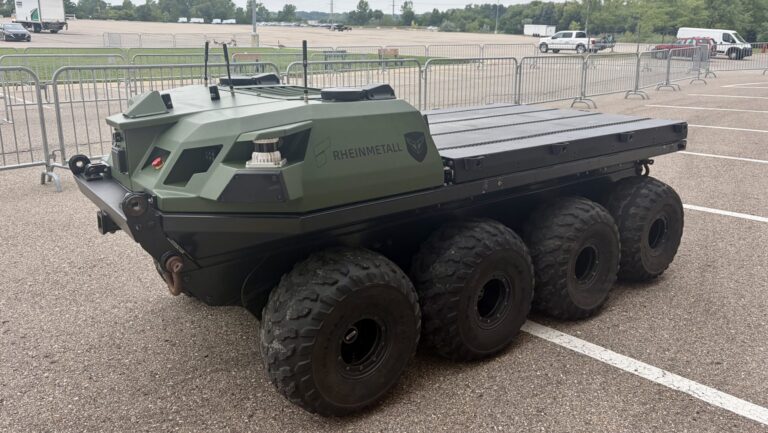
Farewell to human risk: Autonomy takes command of the „last tactical mile” Companies such as American Rheinmetall, Overland AI, and Forterra will deliver autonomous vehicle prototypes capable of operating in extreme terrain and under enemy fire. These systems, including platforms like Mission Master SP-H or ULTRA, will undergo rigorous operational evaluation in 2027, with troop feedback being essential for the final mass production decision of the next generation of robotic infantry assistants.