In halls the size of football fields, where the hum of machinery and conveyor belts marks the beginning of a radical transformation, U.S. military officials have unveiled an ambitious plan for national security. The United States is shifting into high gear for the production of critical drone components, attempting to compress processes that typically took years into just weeks or months.
Strategic independence as the Pentagon prioritizes domestic manufacturing to counter foreign reliance
This industrial offensive is part of an advanced manufacturing strategy set to be officially released in the coming weeks. The central objective is „Drone Dominance,” a Department of Defense initiative designed to eliminate critical dependence on foreign-made components, particularly those sourced from China.
The transformation is not just technological, but cultural. „How do you take a culture that typically has five to eight years to stand something up and do it in weeks and months?” noted Jonathan Strzelec, chief of Tobyhanna’s Transformation Office. The answer lies in close collaboration with private industry and unprecedented flexibility in logistical processes.
Massive industrial scaling for the motors and circuits that power the modern battlefield
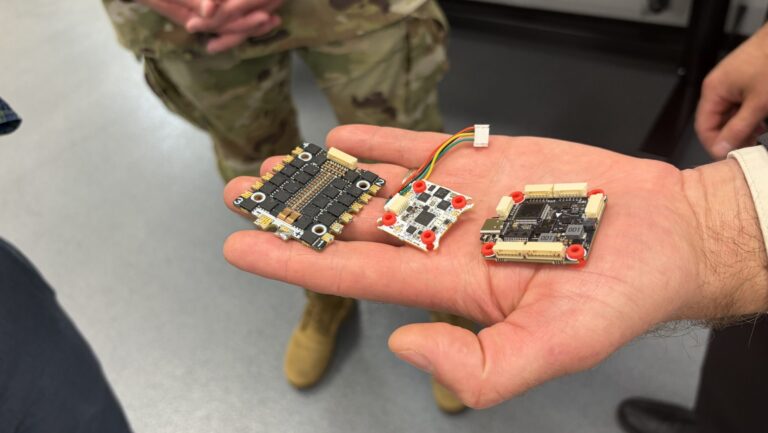
The Army has focused on two vital but extremely difficult components to produce locally: brushless motors and circuit card assemblies. The latter serve as the „brain” of a drone, responsible for real-time video transmission, GPS functions, and motor speed control.
The new assembly line for motors has an initial goal of 200,000 units, with a production capacity of up to 1,500 motors per day. This production rate is sufficient to equip 375 drones daily, as each aircraft utilizes four such motors. In parallel, work is underway on a circuit card assembly line that, by the end of fiscal year 2027, is expected to produce one million units annually, eliminating the need to purchase from unreliable external sources.
Public-private partnerships to bridge the gap between innovation and mass production
The Army’s vision involves a unique economic model: small vendors, often backed by venture capital, will be able to rent military equipment and facilities. This arrangement allows innovative firms to avoid the massive costs and time required to build their own factories, facilitating rapid scaling at a lower cost.
These public-private partnerships are essential for bringing private sector agility into the heart of the Army’s industrial base. „It’s about changing how we think about the Organic Industrial Base and how we leverage the sum of its parts to make a much better whole,” explained Colonel James Crocker.
A flexible industrial base ready to support the commercial sector in times of national crisis
A remarkable aspect of these new production lines is their versatility. The technology used for drone components can be adapted with minimal changes to produce parts needed for military vehicles or even the civilian industry.
Officials indicated that in the event of a national need—such as the semiconductor crisis during the pandemic that stalled major automakers—Army facilities could be opened through legal agreements to manufacture circuits for companies like Ford or General Motors. This ability to pivot between defense and commercial needs transforms military industrial bases into a vital strategic asset for the entire American economy.