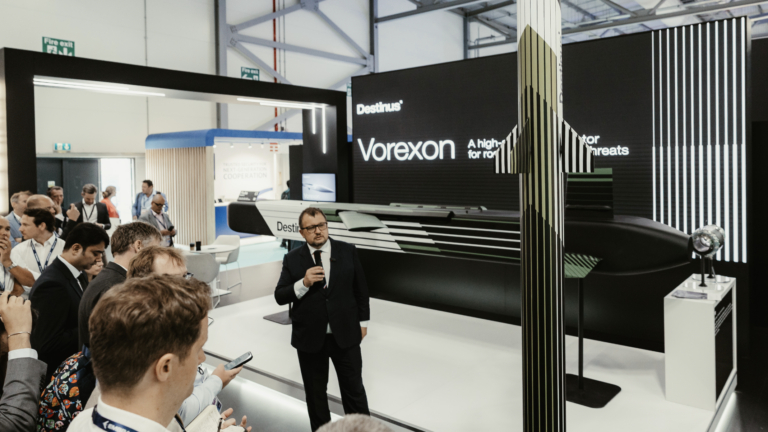
The Dutch company Destinus has unveiled a new counter-rocket interceptor designed to address critical vulnerabilities within Europe’s integrated air defense architecture. Dubbed Vorexon, this ground-based interceptor promises to swiftly detect and identify incoming projectiles, ensuring the protection of priority assets through intelligent threat engagement.
Speeds exceeding Mach 2 and precision under human command
Currently under development, the Vorexon system is engineered to reach a maximum speed above Mach 2 with an operational range exceeding 20 kilometers. The technology operates within an integrated sensor and fire-control network, utilizing external radars to spot and classify incoming shells. Upon launch, the interceptor receives midcourse corrections until its onboard radar locks onto the target for the final strike. A key feature highlighted by the developers is that the ultimate engagement decision remains strictly under human operator command.
Cost efficiency: A lesson learned from the Ukrainian front
The development of Vorexon serves as a direct response to the realities of modern warfare, where heavy artillery bombardments have shown that using high-cost interceptors to stop inexpensive rockets is economically unsustainable. At present, no defense architecture can engage every incoming round without exhausting the defender’s financial resources. Vorexon aims to rebalance this dynamic by providing a scalable solution against artillery rockets and glide bombs, which are mass-produced at a low cost.
Deployment timeline and protection of critical infrastructure
Destinus expects Vorexon to undergo operational testing next year, targeting the launch of mass production by 2028. The system is designed to safeguard strategic sites such as command posts, logistics hubs, ammunition stores, and air-defense batteries. While no official launch customers have been announced, the company confirmed ongoing discussions with several European nations, including Ukraine, where other technologies from the firm, such as the RUTA Block 2 mini-cruise missile, are already in use in the current conflict.