China’s trial blockade and Washington’s muted response
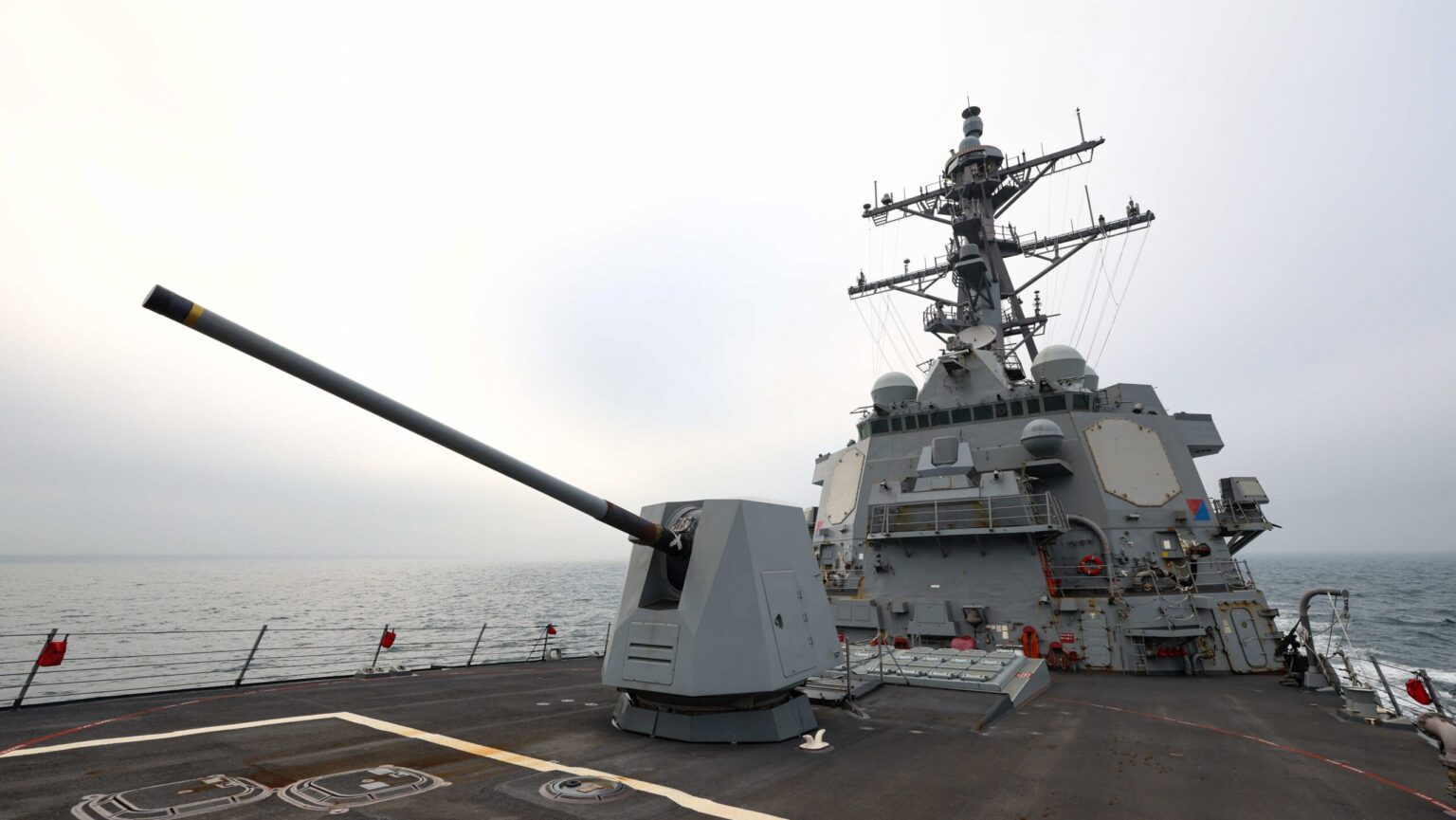
In December 2025, Chinese forces staged high-intensity military exercises around Taiwan that, for the first time, featured a mock, full-scale air and naval blockade of the island. Weeks later, two US Navy vessels entered the Taiwan Strait, conducting the first naval transit of 2026.
That passage provided reassurance to some regional capitals, particularly Taipei. Yet it remains the only publicly declared Taiwan Strait transit by the US Navy so far this year, and just one of three since the start of the second Trump administration. Measured against past practice, this sharp drop is occurring just as Chinese military coercion is ramping up — a juxtaposition that is causing mounting concern.
From dozens of transits to half the pace
An analysis of Taiwan Strait transits — drawing on official US and foreign government statements, press reporting, US naval releases and specialized databases — identified 28 naval transits during the first Trump administration and 32 under President Biden.
By contrast, current trends project just 14 publicly reported transits for the entirety of Trump’s second term — roughly a 50 percent decline from Trump 1.0 and a 56 percent drop from the Biden years. If America’s presence in one of the world’s most contested waterways is quietly fading, the strategic implications could be profound.
A central stage for contesting Beijing’s maritime claims
The Taiwan Strait has long been a flashpoint, marked by periodic crises and competing territorial claims. Beijing asserts that the Strait constitutes Chinese territorial waters, a position almost no other country — including the United States — recognizes as lawful or legitimate.
In this environment, military transits through the Strait have become a key tool for preventing the normalization of China’s expansive claims. US and allied warships deliberately sail through zones unilaterally declared by Beijing in order to contest unrecognized authority and to affirm freedom of navigation.
US presence vs. China’s new “normal” around Taiwan
Equally important, these transits visibly project US military presence at a time when Chinese vessels and aircraft have become a routine, near-constant feature around Taiwan. Since then–Speaker Nancy Pelosi’s 2022 visit to the island, Chinese air and naval activity near Taiwan has surged, with incursions into the island’s airspace and surrounding waters occurring on an almost daily basis.
On a typical day, roughly five or six Chinese warships are reported operating around Taiwan. The US Department of Defense’s 2025 China Military Report noted that China’s “daily activity around the island, near weekly joint combat patrols, and response exercises conducted during periods of heightened political tensions” have each hit successive yearly highs.
Salami-slicing tactics to erode Taiwan’s vigilance
Beijing has also stepped up lower-level coercive measures, including the cutting of undersea cables and unlawful stops and inspections of Taiwanese vessels. These “salami-slicing” tactics are specifically designed to wear down the vigilance of Taiwan’s government and normalize heightened pressure over time.
Despite this pattern, China has so far refrained from launching a full-scale invasion. A central reason is the prospect of US intervention — a perception sustained in part by regular US naval presence — which complicates Beijing’s efforts to achieve the “strategic decisive victory” envisioned by Chinese leader Xi Jinping.
Operational know-how at risk — and a possible green light for Beijing
Transits also have a hard operational value: they give the US Navy hands-on experience navigating and operating in the Strait’s politically charged and militarily complex waters. A prolonged downturn in such operations would not only reduce visible presence, but could also erode practical operating experience in the very theater where it may someday be needed most.
At the same time, a less visible US profile risks being read in Beijing as a sign that Washington is less willing to take political and military risks over Taiwan. That perception could embolden China to pursue ever more coercive, illegal and destabilizing military activities, calculating that the likelihood of a direct American response is diminishing.
Do the numbers matter — or just the quality of presence?
Not all analysts accept that fewer transits are inherently alarming. Former Pentagon official Drew Thompson has argued that Taiwan Strait transits are “just one aspect of U.S. military presence” and should be judged qualitatively rather than purely by the numbers.
While that point is valid, the frequency and visibility of transits play a disproportionately large role in signaling non-recognition of China’s maritime claims. When US and Canadian warships conducted a joint passage through the Strait in October 2024, for example, Taiwan’s Ministry of Foreign Affairs praised the operation as “concrete actions to safeguard Taiwan Strait peace,” noting that it was “the fourth joint transit in under two years.” Such operations are among the clearest ways Washington can demonstrate its commitment to navigational rights, in both word and deed.
“Silent transits”: compromise measure or source of confusion?
Some observers attribute the recent decline in public announcements to a rise in so-called “silent transits,” where the Pentagon chooses not to publicize passages through the Strait in order to dampen tensions with Beijing. China has repeatedly condemned Taiwan Strait transits and accused the United States of generating “public hype” by advertising them.
Taken together with President Donald Trump’s growing openness to expanded diplomatic and economic engagement with China in his second term, this explanation appears plausible. The transit of the USS Higgins alongside the UK’s HMS Richmond in September 2025, for instance, was not formally publicized and was later confirmed only by a Pentagon official, without a Navy press release.
Silent transits are clearly preferable to no activity at all. Yet they also sharply limit the signaling effect to allies and the broader international community. A visible drop in declared operations can therefore weaken perceptions of US priorities and credibility in both friendly and adversarial capitals.
Perceptions of retreat are hard to undo
The timing of this trend is particularly problematic. Chinese maritime coercion is not easing in a reciprocal cycle of de-escalation; it is accelerating. In that context, any apparent tapering of long-running demonstrations of US presence, commitment and deterrence risks being interpreted as a strategic pullback.
Even if undeclared transits are quietly filling some of the operational gap, there is a real danger that US allies and partners — and certainly Beijing — could misread the Trump administration’s approach as a retreat from longstanding commitments. Once such perceptions take hold, they can prove extremely difficult to reverse.
A clear recommendation: restore a steady, public transit tempo
Against this backdrop, the core policy argument is straightforward: the Pentagon should restore the standard tempo of publicly announced, routine transits established under the previous two administrations. A clear, consistent and transparent pattern of operations would send an unmistakable message of continuity in US policy toward the Taiwan Strait: Beijing’s unlawful maritime claims will not be accepted, and freedom of navigation in one of the world’s most critical waterways remains a non-negotiable American interest.