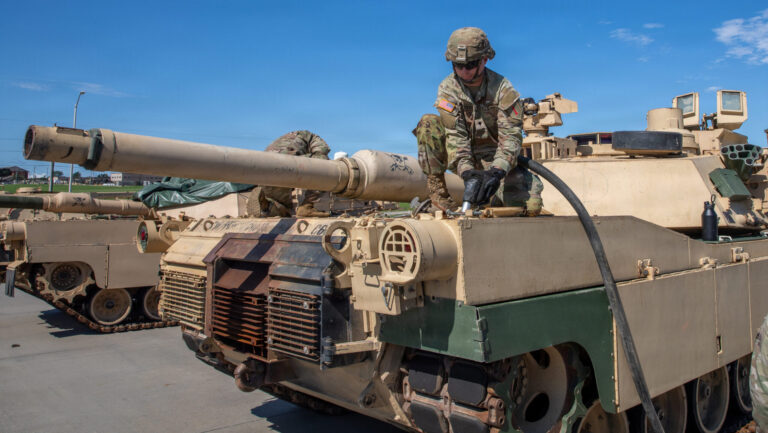
The backbone of American ground power, the M1 Abrams tank, is facing an unexpected enemy: supply chain paralysis. Due to critical bottlenecks in engine production, numerous combat units are currently sidelined, forcing the Pentagon to seek private sector ingenuity to restore defense capabilities.
Component Gridlock: When Logistics Becomes the Main Enemy
The core of the issue lies with the AGT1500 engine, the propulsion heart of the Abrams tank. Supply deficiencies are primarily affecting subcomponents manufactured by sub-vendors. These delays, which can range from several months to a full year, have left numerous tanks idle and unable to operate in field missions.
Military officials warn that combat readiness rates are directly declining due to these missing parts, transforming a logistical headache into a strategic vulnerability.
The TIGER Hackathon: General Mobilization for Engine Revitalization
To counter this decline, the Army recently hosted an industrial „hackathon” under the codename TIGER (Total Integrated Engine Revitalization). Far from a software coding competition, the event gathered over 40 vendors and high-level military leaders under the direct oversight of Lt. Gen. Christopher Mohan.
The goals are clear and urgent: finding second sources for critical components, recruiting companies capable of advanced manufacturing, and securing necessary raw materials. „We have backing all the way up the chain to make this work. When you have that kind of brass behind an initiative, things move,” logistics officials stated.
Industrial Sovereignty and 3D Printing: The Race for Critical Parts
Technical analysis has identified 166 critical components directly impacting delivery timelines and fleet readiness. Interestingly, the Army owns the intellectual property for 122 of these, providing the government with significant leverage to expand the industrial base.
However, the major challenge remains manufacturing technology. Certain parts, such as turbine impellers, require complex vacuum forge processes—expertise that is extremely rare in today’s industry. To overcome these choke points, officials are betting on cutting-edge technologies, including aerospace-grade 3D printing, to produce parts with an extremely high level of precision.
October 1st Horizon: Betting on Non-Traditional Commercial Partners
The plan of attack involves releasing official partnership solicitations in the coming days, with the ambitious goal of having new vendors under contract by October 1st.
The Army’s great hope lies in „non-traditional” vendors—commercial companies that haven’t previously operated in the defense sector but possess the technology needed to bring resiliency to a fragile system. The success of this endeavor will decide not only the fate of the „Tiger” engine but also the overall responsiveness of the entire Abrams fleet in the years to come.