To maintain its edge against adversaries, particularly China in the Indo-Pacific, the Air Force must prioritize investment in command and control (C2) capabilities, a senior Air Force official emphasized on Tuesday.
C2 Capabilities Lagging Behind
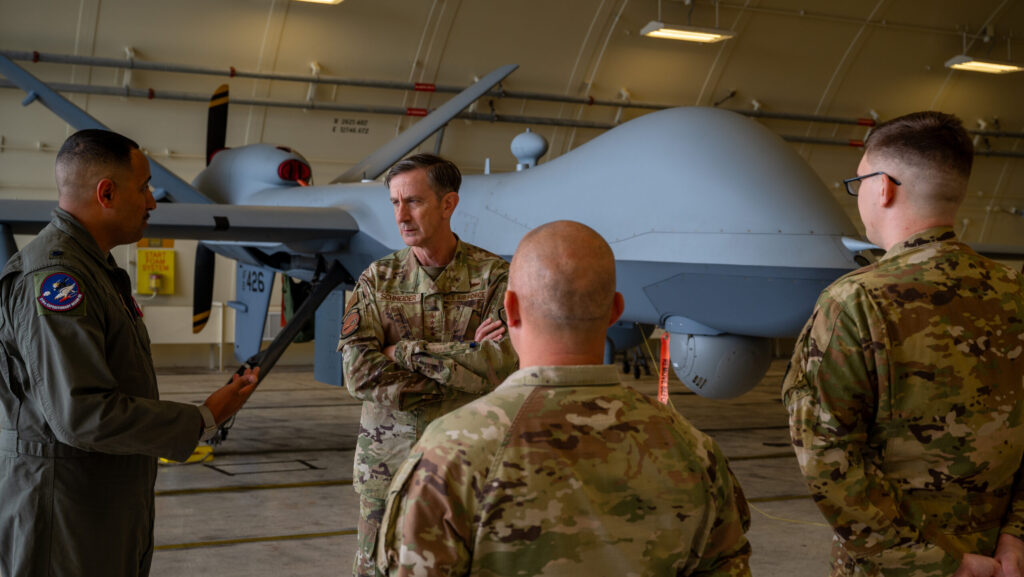
Pacific Air Forces Commander Gen. Kevin Schneider, during a virtual discussion hosted by the Mitchell Institute, acknowledged that his command may not currently possess the necessary personnel to effectively perform C2 battle management functions. He stressed that command and control is the foundation upon which air superiority, mobility, and other critical missions rely, requiring continuous investment and improvement in people, systems, and processes.
C2: Directing Forces in the Field
C2 battle management, the Pentagon’s term for directing tactical forces to achieve objectives, involves a complex network of sensors, communication systems, data analytics, and skilled personnel. Military officials caution that adversaries like China would likely target C2 capabilities to disrupt and disorient US forces in a conflict.
Foundation for Modernized Platforms
Schneider emphasized that investing in C2 battle management is crucial to maximizing the potential of modernized platforms like the upcoming B-21 Raider stealth bomber and F-47 sixth-generation fighter. He argued that C2 investments can yield near-term benefits, even before other modernization efforts fully materialize.
Air Force’s Multi-Layered Approach to C2
The Air Force employs various methods for managing forces in battle, including air operation centers on the ground and airborne platforms like the E-3 Sentry. The long-term goal is to establish an integrated global network, known as Combined Joint All Domain Command and Control (CJADC2), to link sensors and shooters.
Air Force’s Contribution to CJADC2
The Air Force’s contribution to CJADC2 is the Department of the Air Force Battle Network, led by Maj. Gen. Luke Cropsey. Schneider advocated for a resilient, layered C2 architecture with multiple pathways for data transmission. This could involve equipping systems like bombers and tankers with specific communications capabilities and sensors, transforming every platform into a C2 node. (Critics have noted that the recent decision to forgo the E-7 Wedgetail surveillance aircraft may complicate Indo-Pacific operations.)
Mirroring Adversary Strategies
Schneider emphasized that the US should adopt a similar strategy to adversaries like China by targeting their C2 capabilities. Future systems should incorporate longer-range detection and weaponry.
Prioritizing C2 Investments
Ultimately, Schneider emphasized that he would prioritize funding for strengthening his own C2 battle management capabilities, stating, „If I had a dollar, or a couple of dollars, that is where I would first look to spend it.”