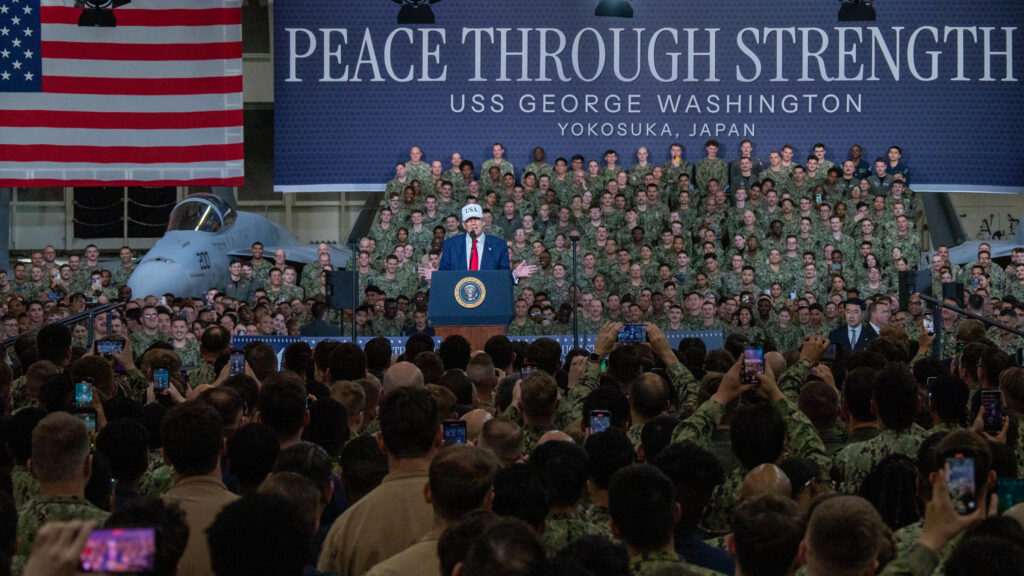
When President Donald Trump declared in September to a group of high-ranking military officers that he was „seriously considering” building „battleships” for the US Navy, the statement raised eyebrows in the naval community. True American battleships, heavily armored to fight gun battles with a peer navy, have been consigned to history since the 1990s. However, a new vision is taking shape at the Pentagon, one that could redefine American naval capabilities and put pressure on an already strained budget.
From Defensive Destroyers to Offensive Power: The „Golden Fleet” Concept
Unlike the past, where modern destroyers, equipped with state-of-the-art radars and interceptors, protect aircraft carriers and their vital air wings – as demonstrated by numerous engagements against the Houthis in the Red Sea – the new initiative proposes a fundamental shift. The White House and Navy are reportedly in early discussions to design a new class of ships, as part of a concept the administration has dubbed „Golden Fleet.”
These modern „battleships” would displace between 15,000 and 20,000 tons – much larger than current destroyers – and would be equipped with premiere offensive strike capabilities such as hypersonic weapons, according to a recent report by The Wall Street Journal, which cited unnamed current and former officials. The broader „Golden Fleet” concept would pair these offensive „battleships” with a myriad of smaller unmanned vessels and corvettes.
A Presidential Vision Aligned with Naval Analysis
Despite the idea ostensibly coming from the White House, it aligns with a theory that has arisen from recent wargames and other analyses, according to Bryan Clark, a retired Navy officer and fellow at the Hudson Institute, who frequently works with the Pentagon as an outside consultant. At least from a strategic standpoint, the Navy’s envisioned future destroyer, DDG(X), lacks the space for the offensive firepower it may need in a future fight.
„To get a ship that’s able to do some offense as well as defense, you need something even bigger [than a destroyer] to have enough missile capacity or to have long-range missiles that don’t fit in the [Vertical Launching System] cell,” Clark explained. „So, either one of those drives you to a new ship design that’s bigger than even DDG(X) was envisioned as being.”
Astronomical Costs: Billions for Each Unit
Designing and building an entirely new class of Navy ships is, however, a prolonged and expensive exercise. Analysts told Breaking Defense that, if the administration follows through on the idea, such a ship could cost upwards of $4 billion per copy – a significant demand on the Navy’s already strained shipbuilding budget. Experts added that the United States’ options for building this new ship are likely limited to two firms: HII or General Dynamics.
„The interesting part of this is it’s not just a kind of fleeting presidential idea, but this is, in fact, something that does kind of resonate with what the Navy’s finding it probably needs to do with the fleet through its own work,” Clark commented. „It’s an interesting juxtaposition of presidential gut [instinct] with [the] Navy’s analysis.”
Spokespeople for the Office of the Secretary of Defense and the Navy deferred comment for this report to the White House. Anna Kelly, White House spokesperson, stated: „President Trump has done more than anyone to bolster America’s maritime dominance — including by securing a $43 billion investment in the Working Families Tax Cut, establishing a White House Office of Shipbuilding, negotiating a historic deal with Finland to construct 11 new arctic cutters, and more. We have no further announcements at this time — stay tuned!”
The Price of a Warship: More Art Than Science
The price tag for a warship comes down to numerous competing factors such as size, design complexity, estimated future inflation, and whether or not the specific ship is first in its class. For example, Arleigh Burke-class destroyers only displace between 8,000 and 10,000 tons – about half that of Trump’s envisioned battleship – but the Navy’s propensity to maximize every inch of available space for new technology makes the Arleigh Burkes technically complex, resulting in recent DDGs costing between $2.5 and $3 billion per ship.
Amphibious ship classes, while many times larger than a destroyer, have a lower overall design complexity because their primary purpose is to haul Marines and their associated platforms and gear. As a result, certain amphibious ships have come in between $2 and $3 billion per ship, depending on the class.
Jonathan Page, a professor at the University of Michigan’s school for naval architecture and marine engineering, who has previously worked on various Navy shipbuilding programs, estimated the new battleship would cost between $4 and $4.5 billion, cautioning, however, that his guess makes a number of assumptions about the ship’s design and other details not publicly available.
Experts emphasize that first-in-class ships are consistently more expensive than their successors because ship design problems and construction errors naturally decrease with each new vessel built. These discrepancies make estimating future ship prices more art than science, especially when discussions are preliminary and details are hypothetical.
Jeff Vogel, an executive at TOTE Services, suggested the lead ship’s price could be as low as $1.6 billion, with future ships nearing $1.2 billion, if the Navy learns from its past mistakes on the Constellation-class frigate program, which is suffering schedule delays and cost overruns in part due to excessive design changes.
Carlton Haelig, a fellow at the Center for a New American Security, predicted the new ship class would be more comparable to the Zumwalt-class destroyers, which have procurement costs between $3.5 and $4.5 billion per ship, on top of the billions that went into design and development. The Zumwalt program, in particular, has had significant schedule and funding issues due to the class being truncated multiple times and the Navy swapping the ship’s mission sets. Haelig noted that the specific weapons the White House is mulling for its new ship class could tremendously drive up the vessel’s overall operating cost.
Traditional Shipbuilders and New Horizons: Who Will Build Them?
Nearly all analysts stated that the most likely shipbuilders capable of constructing this new warship are either HII’s Ingalls Shipbuilding or General Dynamics Bath Iron Works. Both companies have extensive experience building surface combatants and shipyards large enough to construct Arleigh Burke-class destroyers and, in Ingalls’ case, even larger amphibious class ships.
A spokesman for Bath Iron Works told Breaking Defense: „We build what our customer requests,” and deferred other questions to the Navy. A spokesperson for HII did not respond to requests for comment.
American shipbuilding has seen significant changes since Trump’s first term in the White House. The United States is more heavily leaning into the capability of its allies and partners, whether that be through the Biden administration’s ICE Pact, the current administration’s deal with Finland for icebreakers, or the numerous industry-to-industry deals signed between American and South Korean companies.
Asked how these new warships could be built without solely relying on HII or GD, Vogel suggested the Navy could farm out certain component production and testing to a smaller network of yards, a concept known as „distributed shipbuilding.” Page, the University of Michigan professor, suggested procuring the hull form or propulsion plant abroad, but added: „Such a construct might add time [to the program schedule]… I am not confident in a solution here similar to the icebreaker pact we just struck with Finland, though, for instance.”
Hunter Stires, who was an advisor to former Navy Secretary Carlos Del Toro, argued the service should conduct a competition between HII and BIW for any future surface combatant rather than allowing a teaming arrangement, which is currently envisioned for the DDG(X) program. He also suggested Hanwha, the South Korean conglomerate that has aggressively pursued a stronger position in the American defense industrial base, could emerge as a third option.
The Budgetary Tightrope: Funding a „Golden Fleet”
As for what all of this means for the Navy’s already strained shipbuilding budget, „something will have to give.” Haelig noted the administration covered a large portion of the service’s shipbuilding budget this year through reconciliation, a „budget trick” he said was unlikely to work twice.
„That sets up a situation in 2027 where there is going to be a discussion about [whether] you roll those shipbuilding costs back into the base budget?” he said. „You’re probably not going to be able to get reconciliation done, and that’s without even considering this idea that we’re going to have to start a whole new program, or series of programs, to manifest the Golden Fleet.”