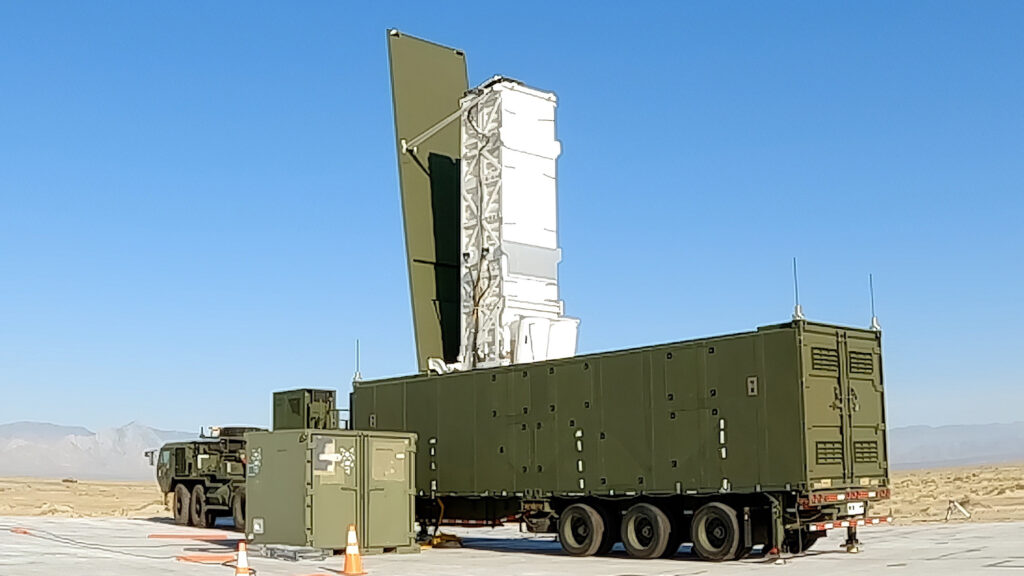
The US Army is reassessing its new Mid-Range Capability (MRC) launcher, Typhon, due to its size hindering battlefield maneuverability. Alternative options, including the future Common Autonomous Multi-Domain Launcher (CAML), are now under consideration, according to top Army officials.
Typhon’s Size a Concern
Lt. Gen. Joel Vowell, Deputy Commanding General for Army Pacific, highlighted Typhon’s considerable size, necessitating a vertical launch setup. The Army is now exploring smaller, potentially semi-autonomous form factors for future long-range strike capabilities.
CAML as a Potential Replacement
Lt. Gen. Robert Rasch, head of the Army’s Rapid Capabilities and Critical Technologies Office (RCCTO), suggested CAML could potentially fulfill the role initially envisioned for Typhon.
Development History and the Need for Agility
RCCTO initially developed Typhon to bridge the gap between the Precision Strike Missile (PrSM) and the Long-Range Hypersonic Weapon (LRHW). The system utilizes a Mark 41 vertical launching system mounted on a 40-foot ISO container, firing SM-6 and Tomahawk missiles. While effective, its size prompted the exploration of a „shrunken” design or the adoption of CAML.
CAML Variants: Medium and Heavy
RCCTO is considering two CAML variants: medium and heavy. CAML-M would likely utilize a Family of Medium Tactical Vehicle (FMTV) to launch Multiple Launch Rocket System (MLRS) munitions or Indirect Fire Protection Capability (IFPC) launchers with AIM-9X interceptors. The larger CAML-H would integrate a launcher onto a M1075 Palletized Loading System tactical vehicle to fire Tomahawk Land Attack Missiles or Patriot Advanced Capabilities Three (PAC-3) Missile Segment Enhancement interceptors.
Long-Term Vision: CAML for All
While CAML’s initial iteration lacks SM-6 compatibility, the long-term goal is to consolidate all capabilities onto CAML launchers, fulfilling Typhon’s original mission.
Rapid Development Timeline
The Army has issued a „request for solutions brief” for CAML, with Lockheed Martin and Raytheon planning to compete. RCCTO aims for rapid development, aligning with Army Chief Gen. Randy George’s goal of fielding working prototypes within 18 months. The focus is on integrating existing technologies rather than developing new missiles or fire control systems.
Challenges: Offensive and Defensive Balance
A key challenge is designing a single platform capable of launching both offensive and defensive weapons, providing soldiers with operational flexibility. This requires careful consideration of the mix between defensive and offensive capabilities.
Logistical Considerations
If CAML is successfully developed, the Army will need to address logistical challenges, particularly for the heavy variant, which may require air transport via C-5 or C-17. Resupply strategies, including autonomous return-to-base and forward resupply, also need to be determined.