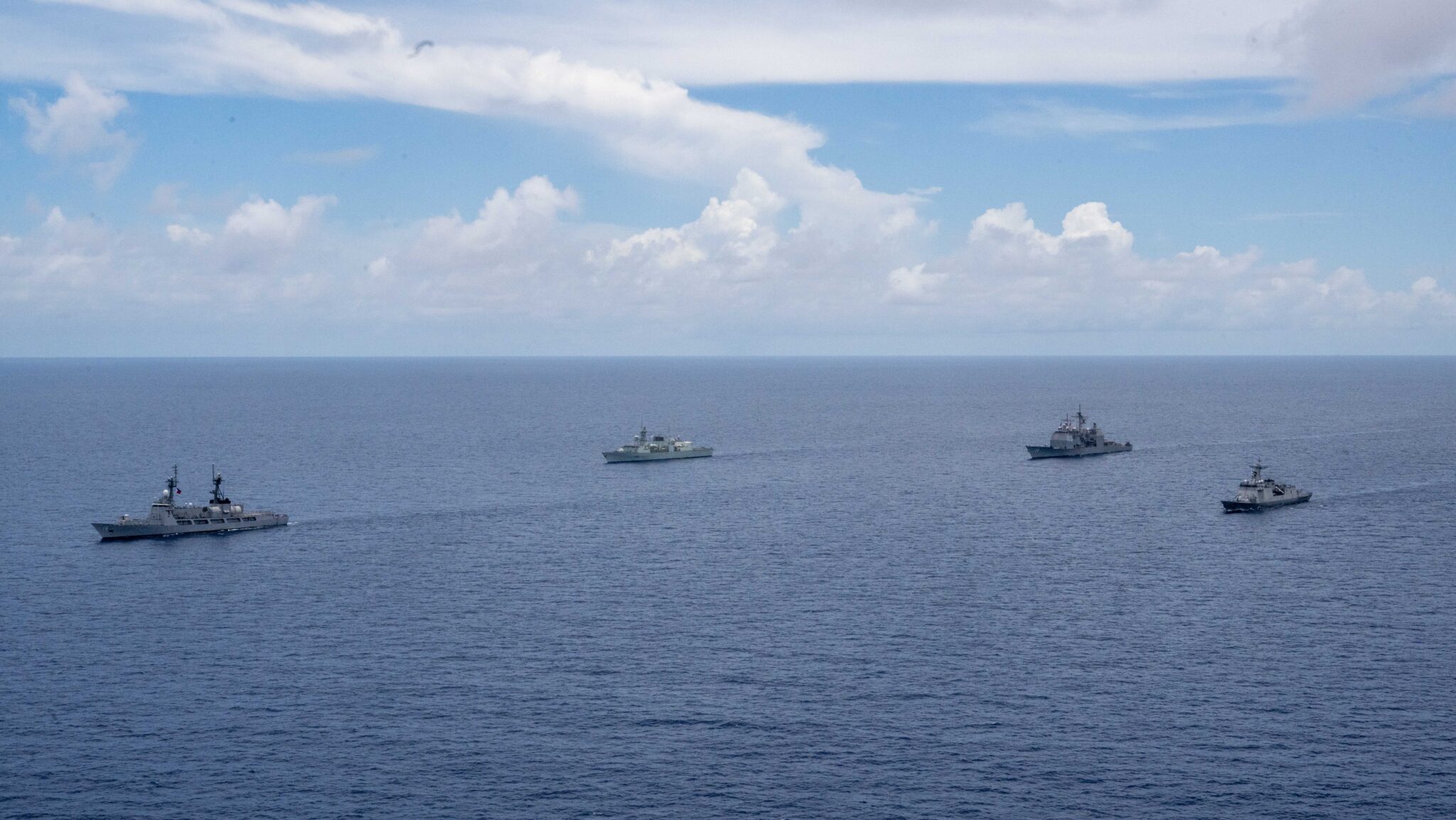
As the foreign and defense ministers from Australia and the United States convene in Washington this week, the Australian military has announced a new Freedom of Navigation Operation (FONOP) involving ships not only from the two allies but also from Canada and the Philippines.
This announcement follows a mid-June FONOP where military vessels from Australia, Japan, Canada, and the Philippines collaborated, suggesting a trend towards expanded multilateral maritime cooperation in the region.
Scheduled for today and tomorrow in the South China Sea, this operation serves as a prominent signal to China, which claims the territory despite a ruling by the International Permanent Court of Arbitration against these claims. Adm. David Johnston, head of the Australian Defense Force, emphasized in the announcement that “our four nations reaffirm the 2016 South China Sea Arbitral Tribunal Award as a final and legally binding decision on the parties to the dispute.”
Collin Joh, an analyst at the Institute of Defense and Strategic Studies at Singapore’s Nanyang Technological University, noted this operation represents a shift from bilateral to trilateral cooperation and now to quadrilateral maritime activities. Joh indicated that this might just be the beginning, as future operations could involve various combinations of participating countries.
“With several agreements in place involving the Philippines and its regional partners, including an upcoming pact with Canada, these joint activities are likely to persist, even if their schedules remain flexible,” Joh stated.
Both Joh and Ian Chong, an associate professor at the National University of Singapore, expressed that they do not anticipate a significant reaction from China once the joint forces are deployed.
Chong explained that any response from China would likely consist of standard messages warning against targeting third parties and criticizing regional powers for escalating tensions in the South China Sea. He also mentioned that it was expected for Beijing to monitor the operations from a distance.
“The risks depend on the types of activities carried out and their locations,” Chong pointed out. He noted that minimal activities near contested areas might compel China to either accept the situation or react strongly. Conversely, cautious actions might be perceived as ineffective.
Neither expert expected a notable response from ASEAN nations. Chong suggested that ASEAN would likely remain silent, with mixed reactions among member states ranging from indifference to veiled criticism, as reflected in Malaysia’s recent statements.
Notably, China conducted a joint sea and air patrol around Scarborough Shoal on Wednesday, according to the Southern Theater Command of the People’s Liberation Army. They stated on social media platform Sina Weibo that “all military activities that disrupt the situation in the South China Sea, create hotspots, and undermine regional peace and stability, are well under control.”