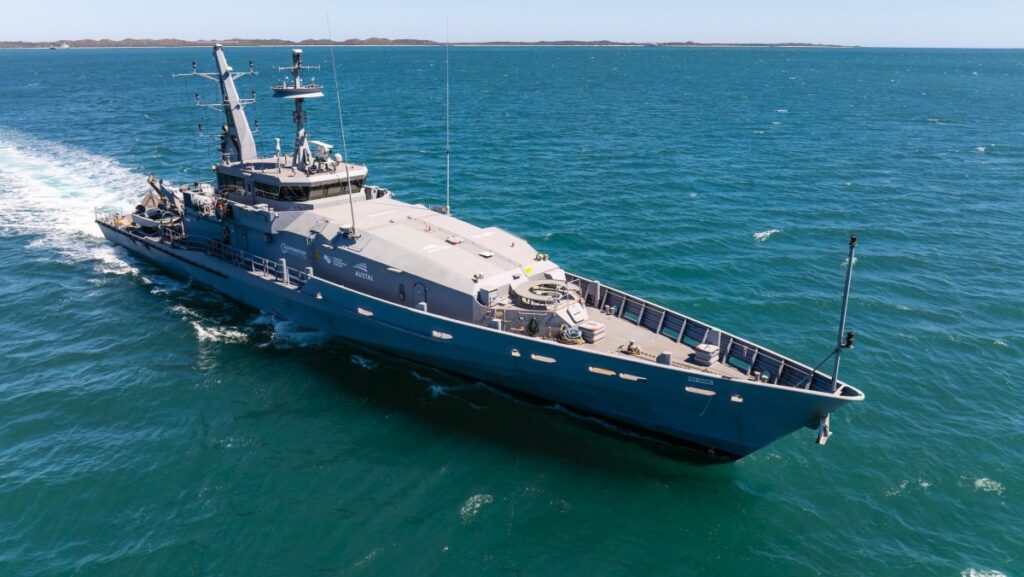
Aiming for rapid transformation: Existing ships can become autonomous in „as little as five days.”
Greenroom Robotics, a Western Australian firm with 35 employees, is collaborating with Australia’s largest shipbuilder, Austal, to enable the easy installation of its autonomous navigation systems on all Austal-built Australian military ships.
According to executives from both companies, the goal is to provide Austal with the ability to convert existing ships into fully autonomous vessels „in as little as five days,” according to a company announcement. The company also claimed competing technologies could take „weeks or months.”
The fact that Austal, a major industrial player in Australia, would entrust such a small startup with the reputation of its fleet is significant. Executives attributed this to confidence gained from shared standards over time and extensive testing conducted by Australia under the supervision of the Royal Australian Navy (RAN).
Greenroom co-founder Harry Hubbert also highlighted that the company’s diverse employee backgrounds – including marine architects, designers, former RAN officers, and a limited number of coders – provided an advantage. Their approach focused on data collection and fusion, transitioning to the ship without prioritizing code perfection.
While acknowledging the need for „tests and trials to ensure vessel safety and readiness,” Hubbert stated that under this agreement, any Austal vessel „can utilize Greenroom software to enable reduced crewing, autonomous operations, or simply enhance safety.”
Greenroom’s Technology: GAMA and Lookout+
Greenroom’s technologies, known as GAMA and Lookout+, employ vision-based AI that gathers data from the ship’s electro-optical sensors and cameras, supplemented by GPS systems. These systems interface with Austal’s Marinelink Prime, which controls the ship’s mechanical systems.
The foundation for the enhanced cooperation between the two companies was established during the Patrol Boat Autonomy Trial. This involved equipping an old Armidale patrol vessel with Greenroom technology and conducting endurance and reliability tests by Austal in April last year.
Growing Market for Autonomous Vessel Technology in Australia
The market for technologies like Greenroom’s is expanding in Australia, with plans to acquire six Large Optionally Crewed Surface Vessels and six Offshore Patrol Vessels. Sam Abbott, head of R&D for Austal, indicated that the optionally crewed vessels would be prime candidates for the Greenroom/Austal technologies.
The RAN will acquire 11 frigates under the $10 billion AUS ($6.5 billion US) program, with the first three ships to be built in Japan and the remainder in Western Australia. While Austal is widely expected to bid on the construction, Abbott declined to comment on whether Austal would bid. Abbott also declined to say whether the Japanese Mogami frigates could be candidates for the autonomy tech.
Focus on Reliability and Redundancy
Reducing the number of sailors onboard to minimize casualties, reduce shipboard space, and extend loitering periods is a key objective for militaries worldwide. However, crew members will still be needed for targeting decisions and system repairs. This is prompting Austal to prioritize building highly reliable systems with redundancy.
„A significant effort for Austal,” Abbott said, „is ensuring vessel systems, especially critical ones like engines, remain available and operational throughout the mission. This involves either improving system reliability or adding redundancy where reliability is insufficient.”
ITAR Exemption Facilitates Technology Transfer
Greenroom has received an ITAR exemption under the AUKUS legislation and regulations passed by the US, Britain, and Australia. These reforms aim to streamline technology transfers as part of the AUKUS agreement.
Hubbert noted that the ITAR exemption has already facilitated conversations and contracts within the three partner nations, particularly regarding data and information sharing.
Autonomy and AI, integral to Greenroom’s products, are key focuses of AUKUS Pillar 2. Australian Defense Minister Richard Marles has lauded the ITAR reforms as a „generational” change. Australian officials have generally been eager to comply with American requirements to align Australia’s arms export system more closely with the US system.
Global Ambitions for Greenroom Robotics
Greenroom recently opened a US office, demonstrating its global aspirations. The company plans to double its workforce by mid-next year, aiming to reach 60-70 employees and further expand to 175 within two to five years. „Our plan, our mission, is to make safe, clean, protected oceans,” Hubbert said, „and to achieve this, we aspire to become the global industrial leader for maritime autonomy and robotics, essentially like the Microsoft of the ocean.”