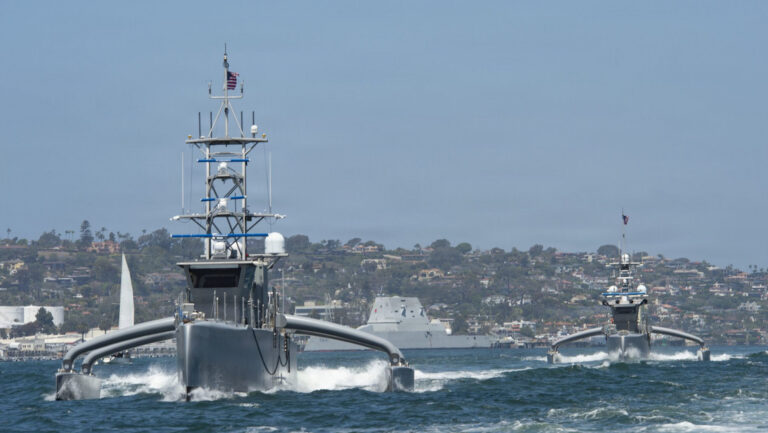
The era of the multi-purpose warship designed to handle any mission anywhere is evolving. US Navy leadership is increasingly convinced that the future of the fleet lies in specialized unmanned systems, rigorously tailored to the specific geography and adversaries of regions like the Persian Gulf, the Black Sea, or the vast Indo-Pacific.
This new operational philosophy, centered on „tailored forces,” marks a strategic departure from the post-Cold War era. While lessons from Ukraine’s successes in the Black Sea or confrontations in the Red Sea are vital, officials warn against over-generalization: what works in a constrained maritime environment cannot simply be copy-pasted into the open ocean.
The Tyranny of Distance: Why Size Matters in the Pacific
Ukraine’s spectacular strikes against the Russian fleet relied on small, inexpensive unmanned vessels capable of hiding in coastal structures. However, this model holds little water in the Pacific, where the lack of cover and the immense distances demand much larger autonomous vessels with long-range endurance and superior seaworthiness.
It is not just a matter of scale, but of environment. Navy experts point out that factors such as water salinity, currents, and local weather patterns directly impact the performance of sonars and sensors. Consequently, the Navy aims to develop „hedge capabilities”—niche solutions for specific missions and geographies—acknowledging that the challenge posed by Russia is fundamentally different from that of China.
The High-Low Mix: Efficiency Over Multi-Billion Dollar Costs
Currently, the mainstay of the surface fleet is the Arleigh Burke-class destroyer—a robust multi-mission platform costing roughly $2.7 billion per unit. Relying solely on these high-end ships for every task is now viewed by military leaders as „the most expensive way to solve every problem.”
The proposed solution is an expanded „high-low mix”: retaining large multi-mission warships while augmenting them with a high volume of Medium Unmanned Surface Vessels (M-USV) and smaller combatants. This approach provides fleet commanders with more tactical options without draining the budget on oversized platforms for routine or specialized missions.
Software-Led Warfare: The Vessel as a „Truck”
Perhaps the most radical shift is the transformation of the ship itself into a delivery vehicle for digital technology. In this new vision, software and information warfare (IW) systems lead the design process, while the vessel’s hull becomes a „commoditized truck” carrying modular payloads.
Through „Containerized Capability” campaigns, the Navy is developing plug-and-play systems—radars, sonars, and jammers—that can be quickly integrated into various unmanned hulls. This modularity allows a drone to be rapidly adapted to its operating environment, either by swapping physical hardware or by training AI algorithms on data specific to that particular region.
This transition will also require a reset of the Navy’s relationship with industry. By moving away from singular, massive contracts, the Navy aims to expand its industrial base laterally, inviting new technological partners to help build a more agile and regionally-responsive fleet.